Pickle Heaven Press-James R. Johnson

something to help you laugh and think about life with Christ

know thyself — March 22, 2026

know thyself

When I’m driving and I think of something I want to remember, I will record a voicemail on my phone and send it to myself.  The problem is, I do this so often that my email provider treats them as spam and blocks them from my inbox. 

How crazy is that – I am being blocked from communicating with myself.  Oh well I guess that’s better than unfriending myself. 

The truth is most of us are somewhat blocked from ourselves.  In other words, we choose to beware of being self-aware.  We don’t fully know who we are, and why we do what we do, and we are naïve as to how we impact others.   And truthfully, some of us don’t want to know. 

This was an issue that Jesus tackled in Luke 6.  He asked, “Why do you see the speck in your brother’s eye, but fail to see the beam of wood in your own? How can you say to your brother, ‘Brother, let me remove the speck from your eye,’ while you yourself don’t see the beam in your own? You hypocrite! – Luke 6:41-42.

Jesus created a comical word picture involving one person with a speck in his eye.  The Greek word for speck is “karphos” which could be a tiny piece of straw or wood.  

But then there was another person who was cursed with a beam in his eye.  The Greek word here is “dokos” which refers to the main beam that supports all the other beams in a roof structure.  The main beam suggests that it was a fundamental flaw in his life. 

Jesus focused on what they saw of each other, but what they failed to see in themselves.  Both were flawed, one a little and the other immensely, but both were blind to their own shortcomings.     

I’m reminded of a story I once read in Readers Digest.  Beatrice Rogers was waiting for her turn to enter the confessional at church.  She happened to hear the priest admonish the person ahead of her.  He said, “Please limit your confession to your own sins.”

As with Jesus’ story, we are probably blinded to ourselves a little or a lot and we need to do something about it.  Jesus said, “First remove the beam from your own eye, and then you can see clearly to remove the speck from your brother’s eye.”  – Luke 6:42.

So, what can we do to open our eyes to ourselves? 

Well, we can pray and ask God to open the eyes of our hearts.   David courageously prayed, “Search me, O God, and know my heart: try me, and know my thoughts” – Psalm 139:23. NASU

But the interesting thing In Jesus story, is that the beam guy was very aware of the failings of the speck guy.  So, what if they were to ask each other to share their observations?

My wife and I have done this for nearly fifty years now.  At bedtime, we pray with each other and read Scripture, but before we do, I ask her, “Have I done any badness today?” 

This is my way of asking her to help me understand how I have impacted her, so I can be a better me.  She answers, I seek her forgiveness and then she turns around and asks me the same question. 

This practice has fabulously helped us to open our eyes to the foolish and hurtful things we bring into our marriage and has made us far better spouses and people because of it.  

I will even occasionally ask my children to let me know if they see any hurtful way in me.

I took this practice to work with me as well.  Periodically I would ask my Elder Board to consider my preaching, and general pastoral ministry and make me aware of anything that might be hurtful.

So, take it from this guy with the beam in his eye.  Make an effort to, “Know Thyself.” 

A PRAYER: Lord, help us to know ourselves.

This has been Jim Johnson and pickleheavenpress.com

May the grace of our Lord Jesus be with you.

Scripture passages are from the NETBible® unless otherwise noted.

feeling useless — March 18, 2026

feeling useless

I had a procedure done recently – a cyst was removed from the back of my head.  The doctor sewed it up and it seemed to be healing fairly well.  But a week later I felt around the wound and found that I had a hole in my scalp about the diameter of a pencil.   

That’s when I told my wife, “I need this like a hole in the head.”   For those of you who were born in this century, that is an idiom – an expression describing something that is useless and unwanted – like that hole.   

Oddly enough, there are times that I feel like I am an idiom (which is not to be confused with idiot.)  I worry about how useful I am. 

Like many of you, I have had a job since I was in my mid-teens.  I enjoy work.  I like to look back on what I have accomplished at the end of the day.   I especially enjoyed my ministry years as a pastor.  People were saved, marriages were mended, the church grew and I was sure that God was happy about it. 

I was never the type to define myself by what I did, but I confess that I tended to justify my existence based on how useful I was.   Especially with God.  I was once such a sinner, that I sorta feel like God takes care of me as long as I am useful to Him. 

When things become useless to us, we take them to a thrift store.  Some of us do that with people.  When they no longer serve our purposes, we drop em like a dirty sock.

I am semi-retired now and I find myself feeling like a mess because I am doing less.  So, does this matter to God?  Is His care for me diminished because my body is decrepit?  Does He overlook me because I can only do 10% of the work, I once did for Him? 

Is God less concerned about me because I am less useful to Him?

Not according to Psalm 23.  I was grazing on it one evening when it occurred to me that I am a sheep.  So, I did some research on how sheep were used in the Biblical era. 

Their primary value to the ancient Hebrews was in their fleece.  They produced some milk but not much of it, and they eventually might become lamb chops, but for the most part, it was the wool they produced that gave them value.

But here’s the thing, the sheep were sheared in the early spring – just that one time a year.

It took a whole year’s worth of shepherding to obtain an average of 7 lbs. of wool per sheep.  The bleating beast proved useful only on that one day of shearing.  And yet, the faithful shepherd provided comprehensive oversight and care for his flock 365 days a year.

So, as I age and become less useful, the 23rd Psalm becomes more precious to me.  David wrote…

“The Lord is my shepherd; I shall not want. He maketh me to lie down in green pastures: he leadeth me beside the still waters.  He restoreth my soul: he leadeth me in the paths of righteousness for his name’s sake.  Yea, though I walk through the valley of the shadow of death, I will fear no evil: for thou art with me; thy rod and thy staff they comfort me.  Thou preparest a table before me in the presence of mine enemies: thou anointest my head with oil; my cup runneth over.  Surely goodness and mercy shall follow me all the days of my life: and I will dwell in the house of the Lord for ever.”  – KJV

Regardless of the level of service we might offer, our shepherd feeds us, waters us and provides rest and healing for us.  He leads and protects us, honors us and plans a wonderful future for us. 

Why does He do this? Because that’s just who He is! 

A PRAYER: Thank you Shepherd for removing the pressure of performance

This has been Jim Johnson and pickleheavenpress.com

May the grace of our Lord Jesus be with you. 

pulling my leg — March 11, 2026

pulling my leg

I have a friend who graduated to glory recently.  A story was told at her service that still has me laughing.   Cindy was relaxing at a friend’s Christmas party.  She was reclining on an upholstered chaise lounge chair

But she began to complain about pain in her leg.   A woman, who she did not know, happened to pass by, and Cindy asked if she would help her with her prosthetic leg.  She pleaded with urgency, “Would you please, please pull it off for me?”    

Touched with compassion, the lady grabbed her foot and began to gently pull.  It wasn’t coming, so she amped up her effort and furiously pulled– until Cindy began to giggle – because she did not have a prosthetic leg.      

The woman was quite upset with Cindy because – well – Cindy had pulled her leg. 

Have you ever felt that way when you read the Bible? – like God is just pulling your leg?   I know I have.

Consider John 1:12 which says, “But as many as received Him, to them He gave the right to become children of God.”  So, it would seem, that a person has the freedom to choose to be saved – NASU.

And yet Ephesians 1:5 says, “He predestined us to adoption as sons through Jesus Christ to Himself, according to the kind intention of His will” – NASU. So here it appears that God sovereignly chooses who will be saved.

And I wonder, “Is God pulling my leg?”  Both passages can’t be true, and yet the Scripture, in many places, affirms both concepts as truth.

Theologians try to resolve this conflict by choosing one side and diminishing the other.  “Well, God chooses those who He knows will trust Him.”  That might make sense to us, but it ends up misrepresenting both sides of the issue.  To choose one side at the expense of the other is to violate the clear teaching of Scripture.

But the real problem here, however, is not the Scripture, but our natural inability to understand it.  

God is our Creator.  His divine intellect is unsurpassed.  But we are the work of His hands.  We have been created by the master Creator.  Our wisdom is therefore absurdly limited as compared to His.   

Things that make perfect sense to Him, we are not even permitted to understand.  Moses reminded us, “The secret things belong to the Lord our God.”- Deut. 29:29. 

For 35 chapters in the book of Job, the suffering patriarch questioned the wisdom, and justice of God.  His friend Elihu finally asked “Who can understand the spreading of the clouds, the thunderings of his pavilion?” – Job 36:29. The answer, of course, is no one but God understands such things.  So, should our faith suffer because we can’t explain every theological nuance? 

God remained silent in the book until chapter 38, where He said to Job, “Who is this who darkens counsel with words without knowledge?” – Job 38:2. In other words, “Job you have no idea what you are talking about.”

Then He proceeded by reminding Job of the myriad of things in the world that God had created, that Job just couldn’t explain.  God poured cold water on Job’s hot-headed arrogance and the man was humbled.

“Then Job answered the Lord: “I know that you can do all things; no purpose of yours can be thwarted; you asked, ‘Who is this who darkens counsel without knowledge?’  But I have declared without understanding things too wonderful for me to know” – Job 42:2-3.

If we could understand everything about God and His ways, well, He wouldn’t be much of a god would He?  I would not want to worship a god that I could fully explain. 

So, I am content to live with what appears to me to be theological contradictions, because I am confident that such things are perfectly understood by our Almighty God – and I’m not pulling your leg. 

A PRAYER: Lord, I trust you what You say, even when I don’t understand it

This has been Jim Johnson and pickleheavenpress,com

May the grace of our Lord Jesus be with you

Passages are from the NETBible ® unless otherwise noted.

submarine races — February 25, 2026

submarine races

It is very important to tell the truth, but is it ever better to wait to tell it? 

We were cruising in the moonlight along the Olentangy River Road.  Across the river was The Ohio State University.   As I gazed through the window, I noticed a very long line-up of cars that were parked along the river. 

I figured some big event was going on so I asked, “Daddy what’s everyone doing?”   He paused and said, “They are watching the submarine races.”   And I said, “Wow, dad, can we go?  Please?  I want to see the races too?”

If you don’t already know, “submarine race” is a euphemism – a figure of speech, from the 1950’s.  It was used to describe couples who were parked along the river for the purposes of making whoopee (which is another euphemism).

I wasn’t old enough then, to understand the attraction of the sexes, so dad ignored me and I stewed in disappointment over having missed the big event.

It certainly is important to tell the truth, but the situation and ability of a person to hear truth needs to be taken into account.  Consider Jesus.

He was gathered with His disciples for their last supper together.   The atmosphere was sober, even tense at times.  During the meal Jesus foretold of the things to come such as His betrayal (John 13:18-30); Peter’s denial (13:36-38); His departure from them (14:1-6) and their rejection by their world (15:18-21; 16:1-3). 

The guys must have been bewildered and disheartened to say the least, but then Jesus added these words, “I have many more things to say to you, but you cannot bear them now” – John 16:12. 

Jesus still had more to say to them – more truth to impart, but He determined that they were just not able at that time to hear any more and to bear the weight of His words.

“But Jesus, didn’t they need the truth, the whole truth and nothing but the truth?”  Yes – they did – but it would be revealed later.  Jesus promised that the Holy Spirit would pick up where He had left off.  The Spirit would soon come and guide them into all truth. (John 16:13)

I have often thought of these words as I have related to other people and have learned that there really are times that we should withhold the truth.  Not to lie, but to be wise about when we speak it.  

– For instance, we need to postpone truth telling when a person is physically not at their best.  If they are in pain, or physically worn out, it’s better to wait.

– We need to hesitate when the person is emotionally stressed.  If they have just lost a loved one they don’t need to hear, nor are they able to hear your well-intentioned advice. 

– When a person isn’t old enough or mature enough to understand the truth, we need to pause. A six-year old doesn’t need a rundown on the dire state of the family’s finances.

– Be considerate if a person is stretched for time.  It isn’t wise for her to talk to him about marriage concerns when he’s walking out the door to go to work.  

Is it important for a person to hear the truth?  It is!  Paul wrote, “each one of you speak the truth with his neighbor” – Ephesians 4:25.   But he also told us to speak the truth in love (Ephesians 4:15). 

I have found that it’s usually better to speak the truth sooner rather than later but speaking the truth in love requires us to be sensitive to timing and circumstances.

Yep, my dad was wise in withholding the truth about what they were doing down by the river.  He did, however, eventually educate me when he gave me the talk on the birds and the bees (which is another euphemism). 

A PRAYER: Lord help me speak the truth, at the proper time so that it gives grace to those who hear.

This has been Jim Johnson and pickleheavenpress.com

May the grace of our Lord Jesus be with you.

Scripture passages are from the NETBible ®

cul-de-sac — February 17, 2026

cul-de-sac

We live on a cul-de-sac – a French term which means, “place where vehicles turn around because the driver is too lazy to put his vehicle in reverse.”  Realtors tout them as places for folks who crave quiet and privacy.  Ours is more like the drive through at Chick-Fil-A at noon.

I suspect that Tripadvisor lists circling our cul-de-sac as the #1 thing to do in White Oak, Texas.  “Where’s Waldo?”  I’ve seen him here.  When the Christmas lights are up, I have watched people revolve around that circle three times to make sure they don’t miss a twinkle.

The actual French translation of the term cul-de-sac is, “the bottom of a sack.” Yep, that’s where I live.

A cul-de-sac is pretty much a dead-end – one way in and one way out. However, you almost never find a sign at the entry to a street with a cul-de-sac warning you that it is a dead-end. 

Which is why more than one person has unknowingly turned down our street, to eventually circle back to where they started.

That sounds a lot like a guy named Samson from the book of Judges.  He started life with two parents that deeply loved the God of Israel.  It is also said that the Lord uniquely blessed him (13:24-25).  Because of this, he was well on the road to success in life, but silly Samson frequently chose streets with cul-de-sacs instead.  

He wanted a wife but looked among women who did not share his faith.  He overruled the objections of his parents and guidelines of his God to get her.  But she betrayed him and then became the wife of his friend (14:1-20).  Samson pursued the cul-de-sac of sensual desire but then found himself alone.

Samson had a big ego.  He wanted to be regarded as witty, so he created a riddle.  He bet the Philistines that they couldn’t figure it out, but they outsmarted him. Samson was humiliated and wreaked revenge by killing 30 of them.  He pursued the cul-de-sac of his ego but found himself humiliated (14:5-20).

The Lord chose Samson to lead His people in the ways of righteousness, but Samson was more concerned with the cul-de-sac of self-determination.   His reckless self-willed behavior caused His people to reject his leadership and then deliver him over to their enemies (15:9-13)

Samson continued to pursue his dead-end cul-de-sacs until the Philistines finally captured him, gouged out his eyes and put him in chains (16:21-27).

If we aren’t careful, we too could naively end up on a street that gets us to nowhere.  The thoroughfare we really need is found in John 14:6, where Jesus said to us, “I am the way…”

Jesus is the way; the only way to the Father, and the only way to do life

When we choose Jesus as the way, we trust Him to forgive our sins and make things right between us and God.  But we also follow the path He lays out for us.  We don’t need GPS because we have His Holy Spirit, to guide and direct us and His Word to fill in all the details.   

It’s a narrow way to be sure.  Jesus said, “How narrow is the gate and difficult the way that leads to life, and there are few who find it! (Matthew 7:13-14)

And once the path is chosen we must not look back.  Jesus also said, “No one who puts his hand to the plow and looks back is fit for the kingdom of God”  Luke 9:62. But it is the way we need to go. 

Are you aware that Luke, in the book of Acts refers to Christians as people of “The Way?”  (Acts 9:2; 19:9; 19:23; 24:14; 24:22)  

I love that!  We are people of the Way – people who follow the Way.  No more dead ends.  No more crazy cul-de-sacs, just sure and steady progress on the highway of life that leads to heaven.    

A PRAYER: Lord, help us avoid the dead-ends of life.  May we walk in the Way.

This has been Jim Johnson and pickleheavenpress.com

May the grace of our Lord Jesus be with you

Scriptures passages are from the NETBible ®

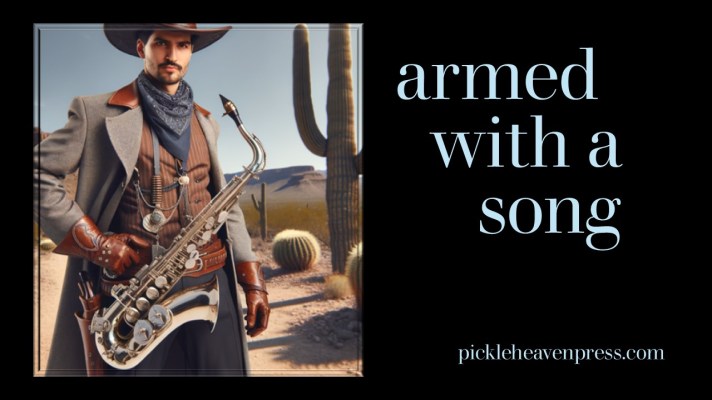
armed with a song — February 11, 2026

armed with a song

One of my Biblical heroes is a king named Jehoshaphat.  In fact, I kinda wish I had named one of my sons Jehoshaphat.  Can I do that retroactively?

The king had a serious problem, and yet isn’t every problem serious?  Some of them really are while others just feel like it.  We would like to trust the Lord to work out our problems.  But is there any evidence that we really and truly trust Him to do that? 

Well let’s consider Jehoshaphat’s problem as written in 2 Chronicles 20. A terrible trio of hostile nations were perched and ready to invade his Kingdom of Judah and things were looking grim. 

But the king had recently discovered that he mattered to God, and that God could be trusted to provide the security that he and his people needed.

So instead of seeking an ally, he called his people together to seek the Lord for help.  God’s spokesman answered saying, “You will not fight in this battle. Take your positions, stand, and watch the Lord deliver you, O Judah and Jerusalem. Don’t be afraid and don’t panic! Tomorrow march out toward them; the Lord is with you!” (20:17).

They were told to meet the enemy, then passively watch as the Lord fought their battle.  They went to meet their foes and did what God told them to do.  They waited and waited but nothing happened.  It was as if God was waiting to see evidence of their faith.

So, Jehoshaphat, “appointed musicians to play before the Lord and praise his majestic splendor.  He instructed them to march ahead of the warriors and sing a song, “Give thanks to the Lord, for his loyal love endures” (21).

Unbelievable!  The king gathered the temple worship team and said, “I want you guys to stand at the front of the column and when you meet the enemy, start singing that song I really like – the one that goes, “Give thanks to the Lord, for his loyal love endures.”

This song was used in the worship services of Israel.  This line was repeated at least 12 different times in the Old Testament in various Psalms   They knew it so well that they didn’t need a video projector for the words.

The singers were speechless, but they thought, “Are you nuts?  What about the archers and swordsmen?  Shouldn’t they go out first?  We left our camo at home.  King these hands were made for plucking a harp not a bow.”  But the King insisted.

So, the trembling tenors took their places at the front of the army, and the sergeant cried, “a one and a two and a…” and by faith they sang.

And then, “When they began to shout and praise, the Lord suddenly attacked the Ammonites, Moabites, and men from Mount Seir who were invading Judah, and they were defeated” (22). 

When they began to sing, the three hostile armies were confounded and then destroyed each other.  They were befuddled and disturbed by Judah’s confidence.

I love this story. Standing and watching was God’s idea. Using the Levitical singers – that was all Jehoshaphat.  And it appears that God was extremely pleased with his decision.

When a problem comes to visit us, I am pretty sure the last thing we want to do is to sing about how good God is.  Our lips are locked; our hearts are numb and there is nothing within us that wants to sing to the Lord

But Jehoshaphat teaches us to meet trouble with a tune.  This is something I have learned to do when trouble comes. 

My heart looks to heaven, and I sing to Him a simple hymn or chorus.  What I find is that my attitude is quickly turned around; and once that has happened, my circumstances are not always but often turned around as well.

When a problem sticks to us, we need to sing to Him!  Solid evidence that we truly trust Him with the problems we face.

A PRAYER: Lord, please give us that kind of courage

This has been Jim Johnson and pickleheavenpress.com

May the grace of our Lord be with you

Scripture passages are from the NETBible ®

heads or tales — February 4, 2026

heads or tales

I think it’s safe now to finally tell my story.  If Sister Aimee Julie is still alive, she would be about 121 years old.  She was my eighth-grade teacher.   If you are reading this post and looking at the picture, I’m not the one in the black habit.  I am the spindly guy next to her. 

From the front of the classroom, sister launched us into a song and then exited the door in the back of the room.  Mario and I sat next to each other at the front of two rows. 

Mario was very Italian.  I’m pretty sure he sprinkled garlic salt on his Captain Crunch, but we were buds because I could make him laugh.

Once sister was gone, I began singing in falsetto – like a girl. Mario cracked up and did the same thing.  Pretty soon the entire class was giggling.  I felt pretty good about myself. 

However, Sister slipped in the back door and saw what was going on, but Mario and I didn’t know it because we had our backs to her.  She marched up the aisle, took Mario’s head in one hand and mine in the other and bashed them together.  We were on the floor – the desks were spilled, books were everywhere and we were seeing stars. 

We picked ourselves up and sat quietly for the rest of the school year.  She had certainly altered my behavior, but not my heart.  I was seething inside.  Still am! I was wrong for sure, but her harshness compelled me to try to justify my behavior.

Though she was a religious person, she was so unlike God. Romans 2:4 says, “Do (you) not know that God’s kindness leads you to repentance?”

When God corrects us, His goal is more than changed behavior, He is after a changed heart.  Harshness hardens a heart and alienates the guilty one, whereas kindness softens a hard-heart and draws us near. 

It was the apostle Paul who recorded Romans 2:4, and no one knew the kindness of God better than he.

He was a persecutor of the early church, known then as Saul.  He delivered Christians to prison and rejoiced when they were executed (Acts 26:10). Saul had legitimately earned a good head-bashing – but the Lord chose to confront his meanness with kindness.

God sovereignly arranged for Saul to be present when Stephen eloquently delivered the good news of Jesus for which Stephen was stoned.  A powerful Gospel seed was planted, and God, like a patient farmer, kindly allowed time for it to germinate in Saul. 

On the road to Damascus the Lord personally spoke to him saying.  “Saul, Saul, why are you persecuting me?” – Acts 9:24. The Lord didn’t gossip about Saul to Michael the Archangel.  He spoke directly to Saul with his carefully worded concern. 

Nor did He attack him in anger but framed His words in terms of the impact of Saul’s actions.  He let him know that he was personally wounded by Saul’s choices.

He used a question not an accusation to start the conversation.  How wise!   Also, the tone of his words suggested that He spoke with sincerity rather than severity.

The Lord didn’t publicly embarrass Saul.  Those with him heard His divine voice but didn’t understand what was said.  His uncomfortable words were for Saul’s ears alone (Acts 22:9).

And instead of an unrelenting berating of Saul for his sins, the Lord gave him a grand positive vision of what he could and would be should he repent. (Acts 26:17-18)

Had Sister Aimee Julie sat us down and had a conversation like that, I would have responded appropriately and repented thoroughly, and I could have avoided my recurring headaches (just kidding about the headaches).  

She did not get the memo, but we have.  When the people in our lives hurt us, disappoint us, disparage us, betray us or even sing in falsetto, confront them with kindness. 

A PRAYER: Lord it is so easy to be cruel, help us to be kind.

This has been Jim Johnson and pickleheavenpress.com  

May the grace of our Lord Jesus be with you

Scripture passages are from the NETBible®

frozen with fear — January 28, 2026

frozen with fear

Someone told me, “You need to get in shape!”  I said “I am in shape. Round is a shape.”

OK I admit I am a mess in more ways than one!  Case in point!   Years ago, my wife observed something odd about me. She asked, “Why do you swing your left arm when you walk, but not your right?” 

Sure enough, as we walked my left arm would swing front to back in sync with my gait, but my right arm was fastened to my side, but I couldn’t explain why.  When I run, both arms are working but not when I walk.

Eventually I came up with the most plausible explanation.  I was ambushed and beaten several times on the walk home from school during High School.  It was terrifying and traumatic.  

The gangs would find me and surround me, but I couldn’t outrun them.  They simultaneously would bust me with their fists and then flee.  And I would pick myself up from the ground, brush away the tears and go home. 

I needed to defend myself, so I began to carry a small bottle opener with a sharp tip.  I carried it in the palm of my right hand.  I deliberately did not swing my right arm when I walked, in order to hide my weapon.

But here it is 50 plus years later and I still walk with my arm glued to my side. Fear has frozen it there.

Some people fear swimming, others flying.  Some avoid crowds while others being alone?  Some avoid hospitals and others public speaking.   Dig deep and you’ll often find a difficult experience that cemented these fears into our psyches.  Christ the Counselor can help! 

His disciples were on a smallish boat at night which was battered by the wind and waves.  That was scary enough, but then an apparition on the water approached them.  Matthew says, “They were terrified and said, “It’s a ghost!” and cried out with fear” – Matthew 14:26.

They were afraid of something they didn’t understand which is true of most fears.  And yet, that scary sight was Jesus.  He was right there in the middle of their fears.  

When we are afraid, we need to Know that Jesus is in the middle of the things that scare us.  There in the foreboding darkness is Jesus who wants to help us confront our fears. 

Jesus spoke to them, “Have courage! It is I. Do not be afraid” – 14:27. If they had known that their powerful Savior was there with them, they wouldn’t have been afraid.  Jesus’ presence is enough to assure us.   He said, “I will never leave you and I will never abandon you” – Hebrews 13:5.

Peter wanted to verify that it was truly Jesus, so he asked the Lord to command him to walk on the water to meet Him (14:28-29).  Jesus did, and Peter jumped out of the boat and tread the angry waves.  Once he knew that Jesus was present, he had the courage to walk towards the very thing that frightened him.  Likewise, We need to walk toward the fears that paralyze us.

Of course, we know what happened next.  Peter took his eyes off Jesus and locked them on the waves – and he began to sink (14:30-31). So, it is with fear.   Even when we have summoned the courage to walk on water, we will falter if we allow the thing we fear become our focus.  We need to fix our eyes on Jesus when our fears try to distract us.

Dr. Erwin Lutzer once said, “When we focus on the very thing that we are trying to get rid of, its power over us actually increases…But if your focus is on Jesus – on your obedience to Him, His power will flow through your whole being and drive away the fear.”

Hmm, maybe it’s time that I quit giving the Lord the stiff arm!

A PRAYER: Lord, I don’t want to be frozen in my fears.  Please thaw me out!

This has been Jim Johnson and pickleheavenpress.com

May the grace of our Lord be with you always.

Scripture references are from the NETBible ®

on-the-spot — January 21, 2026

on-the-spot

It can be terrifying when life puts us – on-the-spot!

It was a gorgeous day for an outdoor wedding.  She was a Texan and he was a Chinese national.  They met on a mission trip and fell in love.  He moved to Texas shortly before they were married. 

I did the premarital counseling with them.  He could speak English well enough, but our culture was certainly a new frontier for him.  I was excited about officiating their wedding. 

He and I were together, waiting for the ceremony to begin.  He was pacing nervously, and I was in a mischievous mood, so I asked, “Are you ready to sing your song?”  Well, his skin tone flashed to pale white. 

“Song, what song?”  “The song” I said.  “You know, the one you’re supposed to sing to your bride just before the vows.”  “I no sing!”  “But it’s our custom. You must.”  “Out there?” “Yes!”

Pretty cruel – I know, but it was such fun.  I quickly told him the truth, however, before he tried to jilt the bride or needed a replacement pair of tuxedo pants.

It can be terrifying when life puts us on-the-spot!   But you know what that’s like…

– the boss unfairly accuses you

– your teen daughter asks to leave with her waiting friend to go to an iffy party

– the teacher looks at your test paper and says, “Is this all there is?”

– the doctor rushes in and asks, “do you want us to resuscitate your mother”

At times like those we need presence of mind, a pulse of less than 200 bpm, and a good dose of wisdom would be great – but all we got is, “Me no sing.”  

Nehemiah found himself in one of those situations.  He was a Jewish slave who was the cupbearer to the king who tasted every drink before it met the lips of the king.  Cupbearers were expendable.  Kings were not.

Nehemiah, however, was distressed about the poor state of his homeland.  He wanted to see Jerusalem thrive again, starting with the rebuilding of her fallen walls.

So, the day came when the King was parched and ready for a glass of Chardonet and Nehemiah was on the job.  And then this happened.  

He said, “I took the wine and gave it to the king. I had not been sad in his presence before; so the king asked me, “Why does your face look so sad when you are not ill?” –  Nehemiah 2:1-2

Nehemiah was so downhearted about his homeland that his happy service to the king was missing.  It was noticed which is why he wrote, “I was very much afraid.” (2:2)

To serve the king required a person to stow their personal issues and provide their personal best.  In those days, failure to do so could have sent him to the executioner.

So, Nehemiah told the king why he was sad.  The king replied, “What is it you want?” (2:4)

Already in trouble for disturbing the king with his personal matters and now locked into a vise-like dilemma – withhold the truth and possibly die for it; or tell the truth and possibly die for it. 

But Nehemiah understood and trusted the God of whom the Psalmist wrote, “God is our refuge and strength, a very present help in trouble.” Psalm 46:10 KJV.  He knew Him to be an on-the-spot God.

So, Nehemiah whispered a very brief prayer to the Lord right there (2:5) and then asked for permission to return and rebuild the walls of Jerusalem.

He sucked in his breath and then waited until the king answered.  Nehemiah could write, “It pleased the king to send me” (2:6).

On-the-spot help.  Just a brief prayer, uttered to a God who Nehemiah knew to be an ever-present help in time of trouble.

When we are suddenly put on the spot – confronted with trouble, He will be there for us as well – just a brief prayer away.

A PRAYER: Lord, please remind me to pray when I am put on the spot

This has been Jim Johnson and pickleheavenpress.com

May the grace of our Lord be with you always

Scripture passages cited from the NIV unless otherwise noted.

when God says no  — January 14, 2026

when God says no 

My grandson sideswiped the neighbor’s brand-new Ford Mustang with his bicycle.  His momma called her car insurance company to see if they would cover the damage. 

The adjuster asked for a description of the vehicle that caused the accident?”   My daughter told him, “It was a Blue Mongoose.” 

With stifled laughter the adjuster said no to the claim!

“No” may be the most ugly and painful word in the English language.  When we have a request, or an expectation of another – we do not want to hear the word “no.”   Especially when that “no” comes from the Lord.

It was early in the ministry of Jesus.  He had debuted His power in the town of Capernaum, where He had healed many of various diseases, and cast out demons (Mark 1:34).  It was a sensational start!   

From there He returned to His hometown of Nazareth and joined the faithful for the Sabbath service.  He read Isaiah 61:1 to them.  

He then said, “Today this scripture has been fulfilled…” – Luke 4:21.  In saying this, Jesus asserted that He was the Messiah of which Isaiah had spoken. 

The folks of Nazareth were pleased.  “All were speaking well of him and were amazed at the gracious words coming out of his mouth” (4:22). The mood in that synagogue was jubilant.  Jesus had become an instant celebrity, and they were ready for Him to bring His healing powers to their little berg.

But they were also wondering, “Isn’t this Joseph’s son?” (4:22). Jesus was a hometown boy from a small town (scholars say about 11-15 families) So those folks knew Jesus all too well.

They watched Him learn to walk, and even cry when He scraped his knee. They touched His calloused carpenter’s hands.  They wondered why his peers took wives, but not Him. 

He was, after all, Joseph’s son. He can’t be the Messiah – can He?   They wanted miracles but were not willing to embrace the miracle worker.  Jesus was aware, and with words that took about 46 seconds to speak, He essentially said no to them.  “I’m not gonna give you the miracles you want to see” (23-27).   

This is how they responded, 28 When they heard this, all the people in the synagogue were filled with rage. 29 They got up, forced him out of the town, and brought him to the brow of the hill on which their town was built, so that they could throw him down the cliff” (4:28-29).

Wow!  When the Lord said no – they went ballistic.  They wanted to kill Him. 

Here’s the thing, sometimes He also says no to us.  “No, I am not going to provide the $500 you are asking for; No, I am not going to heal you, at least right now; No, I’m not going to change your brother’s heart.” 

Sometimes He says no because we ask with the wrong motives (James 4:3).  Or because it would be detrimental for us to have what we ask (Matthew 20:22).  Sometimes as with the folks at Nazareth, He says no to our prayers because we want the blessing without the blesser.   

Some respond to His denial, by pushing Him off the cliff of our consciousness.  “I am done with Jesus.  If He were a good God, He would have said yes.  If He were all powerful, He could have answered my prayer.  If He were all knowing, He would know how badly I want what I am asking.” 

But He is a good God, He is all powerful and all knowing.  And when He says no, it is very much because He is a good, all-powerful and all-knowing God. 

When He says no to us, we would be wise to say to Him, “Lord I may not appreciate this right now, by I am trusting that You are doing what’s right by me.

Amen? 

A PRAYER: Lord tune up my prayers, and give me grace when You say no.

This has been Jim Johnson and pickleheavenpress.com

May the grace of the Lord Jesus be with you

All Scripture references are from the NETBible ®