Pickle Heaven Press-James R. Johnson

something to help you laugh and think about life with Christ

cul-de-sac — February 17, 2026

cul-de-sac

We live on a cul-de-sac – a French term which means, “place where vehicles turn around because the driver is too lazy to put his vehicle in reverse.”  Realtors tout them as places for folks who crave quiet and privacy.  Ours is more like the drive through at Chick-Fil-A at noon.

I suspect that Tripadvisor lists circling our cul-de-sac as the #1 thing to do in White Oak, Texas.  “Where’s Waldo?”  I’ve seen him here.  When the Christmas lights are up, I have watched people revolve around that circle three times to make sure they don’t miss a twinkle.

The actual French translation of the term cul-de-sac is, “the bottom of a sack.” Yep, that’s where I live.

A cul-de-sac is pretty much a dead-end – one way in and one way out. However, you almost never find a sign at the entry to a street with a cul-de-sac warning you that it is a dead-end. 

Which is why more than one person has unknowingly turned down our street, to eventually circle back to where they started.

That sounds a lot like a guy named Samson from the book of Judges.  He started life with two parents that deeply loved the God of Israel.  It is also said that the Lord uniquely blessed him (13:24-25).  Because of this, he was well on the road to success in life, but silly Samson frequently chose streets with cul-de-sacs instead.  

He wanted a wife but looked among women who did not share his faith.  He overruled the objections of his parents and guidelines of his God to get her.  But she betrayed him and then became the wife of his friend (14:1-20).  Samson pursued the cul-de-sac of sensual desire but then found himself alone.

Samson had a big ego.  He wanted to be regarded as witty, so he created a riddle.  He bet the Philistines that they couldn’t figure it out, but they outsmarted him. Samson was humiliated and wreaked revenge by killing 30 of them.  He pursued the cul-de-sac of his ego but found himself humiliated (14:5-20).

The Lord chose Samson to lead His people in the ways of righteousness, but Samson was more concerned with the cul-de-sac of self-determination.   His reckless self-willed behavior caused His people to reject his leadership and then deliver him over to their enemies (15:9-13)

Samson continued to pursue his dead-end cul-de-sacs until the Philistines finally captured him, gouged out his eyes and put him in chains (16:21-27).

If we aren’t careful, we too could naively end up on a street that gets us to nowhere.  The thoroughfare we really need is found in John 14:6, where Jesus said to us, “I am the way…”

Jesus is the way; the only way to the Father, and the only way to do life

When we choose Jesus as the way, we trust Him to forgive our sins and make things right between us and God.  But we also follow the path He lays out for us.  We don’t need GPS because we have His Holy Spirit, to guide and direct us and His Word to fill in all the details.   

It’s a narrow way to be sure.  Jesus said, “How narrow is the gate and difficult the way that leads to life, and there are few who find it! (Matthew 7:13-14)

And once the path is chosen we must not look back.  Jesus also said, “No one who puts his hand to the plow and looks back is fit for the kingdom of God”  Luke 9:62. But it is the way we need to go. 

Are you aware that Luke, in the book of Acts refers to Christians as people of “The Way?”  (Acts 9:2; 19:9; 19:23; 24:14; 24:22)  

I love that!  We are people of the Way – people who follow the Way.  No more dead ends.  No more crazy cul-de-sacs, just sure and steady progress on the highway of life that leads to heaven.    

A PRAYER: Lord, help us avoid the dead-ends of life.  May we walk in the Way.

This has been Jim Johnson and pickleheavenpress.com

May the grace of our Lord Jesus be with you

Scriptures passages are from the NETBible ®

armed with a song — February 11, 2026

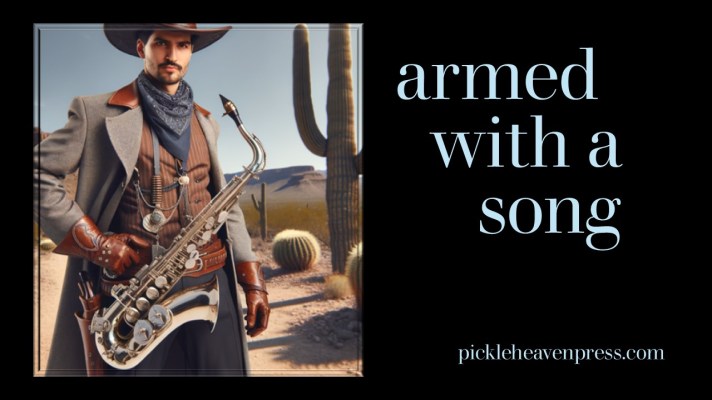
armed with a song

One of my Biblical heroes is a king named Jehoshaphat.  In fact, I kinda wish I had named one of my sons Jehoshaphat.  Can I do that retroactively?

The king had a serious problem, and yet isn’t every problem serious?  Some of them really are while others just feel like it.  We would like to trust the Lord to work out our problems.  But is there any evidence that we really and truly trust Him to do that? 

Well let’s consider Jehoshaphat’s problem as written in 2 Chronicles 20. A terrible trio of hostile nations were perched and ready to invade his Kingdom of Judah and things were looking grim. 

But the king had recently discovered that he mattered to God, and that God could be trusted to provide the security that he and his people needed.

So instead of seeking an ally, he called his people together to seek the Lord for help.  God’s spokesman answered saying, “You will not fight in this battle. Take your positions, stand, and watch the Lord deliver you, O Judah and Jerusalem. Don’t be afraid and don’t panic! Tomorrow march out toward them; the Lord is with you!” (20:17).

They were told to meet the enemy, then passively watch as the Lord fought their battle.  They went to meet their foes and did what God told them to do.  They waited and waited but nothing happened.  It was as if God was waiting to see evidence of their faith.

So, Jehoshaphat, “appointed musicians to play before the Lord and praise his majestic splendor.  He instructed them to march ahead of the warriors and sing a song, “Give thanks to the Lord, for his loyal love endures” (21).

Unbelievable!  The king gathered the temple worship team and said, “I want you guys to stand at the front of the column and when you meet the enemy, start singing that song I really like – the one that goes, “Give thanks to the Lord, for his loyal love endures.”

This song was used in the worship services of Israel.  This line was repeated at least 12 different times in the Old Testament in various Psalms   They knew it so well that they didn’t need a video projector for the words.

The singers were speechless, but they thought, “Are you nuts?  What about the archers and swordsmen?  Shouldn’t they go out first?  We left our camo at home.  King these hands were made for plucking a harp not a bow.”  But the King insisted.

So, the trembling tenors took their places at the front of the army, and the sergeant cried, “a one and a two and a…” and by faith they sang.

And then, “When they began to shout and praise, the Lord suddenly attacked the Ammonites, Moabites, and men from Mount Seir who were invading Judah, and they were defeated” (22). 

When they began to sing, the three hostile armies were confounded and then destroyed each other.  They were befuddled and disturbed by Judah’s confidence.

I love this story. Standing and watching was God’s idea. Using the Levitical singers – that was all Jehoshaphat.  And it appears that God was extremely pleased with his decision.

When a problem comes to visit us, I am pretty sure the last thing we want to do is to sing about how good God is.  Our lips are locked; our hearts are numb and there is nothing within us that wants to sing to the Lord

But Jehoshaphat teaches us to meet trouble with a tune.  This is something I have learned to do when trouble comes. 

My heart looks to heaven, and I sing to Him a simple hymn or chorus.  What I find is that my attitude is quickly turned around; and once that has happened, my circumstances are not always but often turned around as well.

When a problem sticks to us, we need to sing to Him!  Solid evidence that we truly trust Him with the problems we face.

A PRAYER: Lord, please give us that kind of courage

This has been Jim Johnson and pickleheavenpress.com

May the grace of our Lord be with you

Scripture passages are from the NETBible ®

heads or tales — February 4, 2026

heads or tales

I think it’s safe now to finally tell my story.  If Sister Aimee Julie is still alive, she would be about 121 years old.  She was my eighth-grade teacher.   If you are reading this post and looking at the picture, I’m not the one in the black habit.  I am the spindly guy next to her. 

From the front of the classroom, sister launched us into a song and then exited the door in the back of the room.  Mario and I sat next to each other at the front of two rows. 

Mario was very Italian.  I’m pretty sure he sprinkled garlic salt on his Captain Crunch, but we were buds because I could make him laugh.

Once sister was gone, I began singing in falsetto – like a girl. Mario cracked up and did the same thing.  Pretty soon the entire class was giggling.  I felt pretty good about myself. 

However, Sister slipped in the back door and saw what was going on, but Mario and I didn’t know it because we had our backs to her.  She marched up the aisle, took Mario’s head in one hand and mine in the other and bashed them together.  We were on the floor – the desks were spilled, books were everywhere and we were seeing stars. 

We picked ourselves up and sat quietly for the rest of the school year.  She had certainly altered my behavior, but not my heart.  I was seething inside.  Still am! I was wrong for sure, but her harshness compelled me to try to justify my behavior.

Though she was a religious person, she was so unlike God. Romans 2:4 says, “Do (you) not know that God’s kindness leads you to repentance?”

When God corrects us, His goal is more than changed behavior, He is after a changed heart.  Harshness hardens a heart and alienates the guilty one, whereas kindness softens a hard-heart and draws us near. 

It was the apostle Paul who recorded Romans 2:4, and no one knew the kindness of God better than he.

He was a persecutor of the early church, known then as Saul.  He delivered Christians to prison and rejoiced when they were executed (Acts 26:10). Saul had legitimately earned a good head-bashing – but the Lord chose to confront his meanness with kindness.

God sovereignly arranged for Saul to be present when Stephen eloquently delivered the good news of Jesus for which Stephen was stoned.  A powerful Gospel seed was planted, and God, like a patient farmer, kindly allowed time for it to germinate in Saul. 

On the road to Damascus the Lord personally spoke to him saying.  “Saul, Saul, why are you persecuting me?” – Acts 9:24. The Lord didn’t gossip about Saul to Michael the Archangel.  He spoke directly to Saul with his carefully worded concern. 

Nor did He attack him in anger but framed His words in terms of the impact of Saul’s actions.  He let him know that he was personally wounded by Saul’s choices.

He used a question not an accusation to start the conversation.  How wise!   Also, the tone of his words suggested that He spoke with sincerity rather than severity.

The Lord didn’t publicly embarrass Saul.  Those with him heard His divine voice but didn’t understand what was said.  His uncomfortable words were for Saul’s ears alone (Acts 22:9).

And instead of an unrelenting berating of Saul for his sins, the Lord gave him a grand positive vision of what he could and would be should he repent. (Acts 26:17-18)

Had Sister Aimee Julie sat us down and had a conversation like that, I would have responded appropriately and repented thoroughly, and I could have avoided my recurring headaches (just kidding about the headaches).  

She did not get the memo, but we have.  When the people in our lives hurt us, disappoint us, disparage us, betray us or even sing in falsetto, confront them with kindness. 

A PRAYER: Lord it is so easy to be cruel, help us to be kind.

This has been Jim Johnson and pickleheavenpress.com  

May the grace of our Lord Jesus be with you

Scripture passages are from the NETBible®

frozen with fear — January 28, 2026

frozen with fear

Someone told me, “You need to get in shape!”  I said “I am in shape. Round is a shape.”

OK I admit I am a mess in more ways than one!  Case in point!   Years ago, my wife observed something odd about me. She asked, “Why do you swing your left arm when you walk, but not your right?” 

Sure enough, as we walked my left arm would swing front to back in sync with my gait, but my right arm was fastened to my side, but I couldn’t explain why.  When I run, both arms are working but not when I walk.

Eventually I came up with the most plausible explanation.  I was ambushed and beaten several times on the walk home from school during High School.  It was terrifying and traumatic.  

The gangs would find me and surround me, but I couldn’t outrun them.  They simultaneously would bust me with their fists and then flee.  And I would pick myself up from the ground, brush away the tears and go home. 

I needed to defend myself, so I began to carry a small bottle opener with a sharp tip.  I carried it in the palm of my right hand.  I deliberately did not swing my right arm when I walked, in order to hide my weapon.

But here it is 50 plus years later and I still walk with my arm glued to my side. Fear has frozen it there.

Some people fear swimming, others flying.  Some avoid crowds while others being alone?  Some avoid hospitals and others public speaking.   Dig deep and you’ll often find a difficult experience that cemented these fears into our psyches.  Christ the Counselor can help! 

His disciples were on a smallish boat at night which was battered by the wind and waves.  That was scary enough, but then an apparition on the water approached them.  Matthew says, “They were terrified and said, “It’s a ghost!” and cried out with fear” – Matthew 14:26.

They were afraid of something they didn’t understand which is true of most fears.  And yet, that scary sight was Jesus.  He was right there in the middle of their fears.  

When we are afraid, we need to Know that Jesus is in the middle of the things that scare us.  There in the foreboding darkness is Jesus who wants to help us confront our fears. 

Jesus spoke to them, “Have courage! It is I. Do not be afraid” – 14:27. If they had known that their powerful Savior was there with them, they wouldn’t have been afraid.  Jesus’ presence is enough to assure us.   He said, “I will never leave you and I will never abandon you” – Hebrews 13:5.

Peter wanted to verify that it was truly Jesus, so he asked the Lord to command him to walk on the water to meet Him (14:28-29).  Jesus did, and Peter jumped out of the boat and tread the angry waves.  Once he knew that Jesus was present, he had the courage to walk towards the very thing that frightened him.  Likewise, We need to walk toward the fears that paralyze us.

Of course, we know what happened next.  Peter took his eyes off Jesus and locked them on the waves – and he began to sink (14:30-31). So, it is with fear.   Even when we have summoned the courage to walk on water, we will falter if we allow the thing we fear become our focus.  We need to fix our eyes on Jesus when our fears try to distract us.

Dr. Erwin Lutzer once said, “When we focus on the very thing that we are trying to get rid of, its power over us actually increases…But if your focus is on Jesus – on your obedience to Him, His power will flow through your whole being and drive away the fear.”

Hmm, maybe it’s time that I quit giving the Lord the stiff arm!

A PRAYER: Lord, I don’t want to be frozen in my fears.  Please thaw me out!

This has been Jim Johnson and pickleheavenpress.com

May the grace of our Lord be with you always.

Scripture references are from the NETBible ®

on-the-spot — January 21, 2026

on-the-spot

It can be terrifying when life puts us – on-the-spot!

It was a gorgeous day for an outdoor wedding.  She was a Texan and he was a Chinese national.  They met on a mission trip and fell in love.  He moved to Texas shortly before they were married. 

I did the premarital counseling with them.  He could speak English well enough, but our culture was certainly a new frontier for him.  I was excited about officiating their wedding. 

He and I were together, waiting for the ceremony to begin.  He was pacing nervously, and I was in a mischievous mood, so I asked, “Are you ready to sing your song?”  Well, his skin tone flashed to pale white. 

“Song, what song?”  “The song” I said.  “You know, the one you’re supposed to sing to your bride just before the vows.”  “I no sing!”  “But it’s our custom. You must.”  “Out there?” “Yes!”

Pretty cruel – I know, but it was such fun.  I quickly told him the truth, however, before he tried to jilt the bride or needed a replacement pair of tuxedo pants.

It can be terrifying when life puts us on-the-spot!   But you know what that’s like…

– the boss unfairly accuses you

– your teen daughter asks to leave with her waiting friend to go to an iffy party

– the teacher looks at your test paper and says, “Is this all there is?”

– the doctor rushes in and asks, “do you want us to resuscitate your mother”

At times like those we need presence of mind, a pulse of less than 200 bpm, and a good dose of wisdom would be great – but all we got is, “Me no sing.”  

Nehemiah found himself in one of those situations.  He was a Jewish slave who was the cupbearer to the king who tasted every drink before it met the lips of the king.  Cupbearers were expendable.  Kings were not.

Nehemiah, however, was distressed about the poor state of his homeland.  He wanted to see Jerusalem thrive again, starting with the rebuilding of her fallen walls.

So, the day came when the King was parched and ready for a glass of Chardonet and Nehemiah was on the job.  And then this happened.  

He said, “I took the wine and gave it to the king. I had not been sad in his presence before; so the king asked me, “Why does your face look so sad when you are not ill?” –  Nehemiah 2:1-2

Nehemiah was so downhearted about his homeland that his happy service to the king was missing.  It was noticed which is why he wrote, “I was very much afraid.” (2:2)

To serve the king required a person to stow their personal issues and provide their personal best.  In those days, failure to do so could have sent him to the executioner.

So, Nehemiah told the king why he was sad.  The king replied, “What is it you want?” (2:4)

Already in trouble for disturbing the king with his personal matters and now locked into a vise-like dilemma – withhold the truth and possibly die for it; or tell the truth and possibly die for it. 

But Nehemiah understood and trusted the God of whom the Psalmist wrote, “God is our refuge and strength, a very present help in trouble.” Psalm 46:10 KJV.  He knew Him to be an on-the-spot God.

So, Nehemiah whispered a very brief prayer to the Lord right there (2:5) and then asked for permission to return and rebuild the walls of Jerusalem.

He sucked in his breath and then waited until the king answered.  Nehemiah could write, “It pleased the king to send me” (2:6).

On-the-spot help.  Just a brief prayer, uttered to a God who Nehemiah knew to be an ever-present help in time of trouble.

When we are suddenly put on the spot – confronted with trouble, He will be there for us as well – just a brief prayer away.

A PRAYER: Lord, please remind me to pray when I am put on the spot

This has been Jim Johnson and pickleheavenpress.com

May the grace of our Lord be with you always

Scripture passages cited from the NIV unless otherwise noted.

when God says no  — January 14, 2026

when God says no 

My grandson sideswiped the neighbor’s brand-new Ford Mustang with his bicycle.  His momma called her car insurance company to see if they would cover the damage. 

The adjuster asked for a description of the vehicle that caused the accident?”   My daughter told him, “It was a Blue Mongoose.” 

With stifled laughter the adjuster said no to the claim!

“No” may be the most ugly and painful word in the English language.  When we have a request, or an expectation of another – we do not want to hear the word “no.”   Especially when that “no” comes from the Lord.

It was early in the ministry of Jesus.  He had debuted His power in the town of Capernaum, where He had healed many of various diseases, and cast out demons (Mark 1:34).  It was a sensational start!   

From there He returned to His hometown of Nazareth and joined the faithful for the Sabbath service.  He read Isaiah 61:1 to them.  

He then said, “Today this scripture has been fulfilled…” – Luke 4:21.  In saying this, Jesus asserted that He was the Messiah of which Isaiah had spoken. 

The folks of Nazareth were pleased.  “All were speaking well of him and were amazed at the gracious words coming out of his mouth” (4:22). The mood in that synagogue was jubilant.  Jesus had become an instant celebrity, and they were ready for Him to bring His healing powers to their little berg.

But they were also wondering, “Isn’t this Joseph’s son?” (4:22). Jesus was a hometown boy from a small town (scholars say about 11-15 families) So those folks knew Jesus all too well.

They watched Him learn to walk, and even cry when He scraped his knee. They touched His calloused carpenter’s hands.  They wondered why his peers took wives, but not Him. 

He was, after all, Joseph’s son. He can’t be the Messiah – can He?   They wanted miracles but were not willing to embrace the miracle worker.  Jesus was aware, and with words that took about 46 seconds to speak, He essentially said no to them.  “I’m not gonna give you the miracles you want to see” (23-27).   

This is how they responded, 28 When they heard this, all the people in the synagogue were filled with rage. 29 They got up, forced him out of the town, and brought him to the brow of the hill on which their town was built, so that they could throw him down the cliff” (4:28-29).

Wow!  When the Lord said no – they went ballistic.  They wanted to kill Him. 

Here’s the thing, sometimes He also says no to us.  “No, I am not going to provide the $500 you are asking for; No, I am not going to heal you, at least right now; No, I’m not going to change your brother’s heart.” 

Sometimes He says no because we ask with the wrong motives (James 4:3).  Or because it would be detrimental for us to have what we ask (Matthew 20:22).  Sometimes as with the folks at Nazareth, He says no to our prayers because we want the blessing without the blesser.   

Some respond to His denial, by pushing Him off the cliff of our consciousness.  “I am done with Jesus.  If He were a good God, He would have said yes.  If He were all powerful, He could have answered my prayer.  If He were all knowing, He would know how badly I want what I am asking.” 

But He is a good God, He is all powerful and all knowing.  And when He says no, it is very much because He is a good, all-powerful and all-knowing God. 

When He says no to us, we would be wise to say to Him, “Lord I may not appreciate this right now, by I am trusting that You are doing what’s right by me.

Amen? 

A PRAYER: Lord tune up my prayers, and give me grace when You say no.

This has been Jim Johnson and pickleheavenpress.com

May the grace of the Lord Jesus be with you

All Scripture references are from the NETBible ®

give it a rest — December 3, 2025

give it a rest

I love nature, unless it is on my porch and armed with stingers.  A family of yellow jackets decided to move into our home.  To exit or enter said home was a big risk.  So, I decided to tackle the problem. 

I sprayed the raiders with Raid.  They fell one at a time.  But with a nest of approximately 5,000, I would poison myself to death before the insects.   The peppermint oil that was recommended refreshed them instead of repelling them.

The fake wasp nest that was guaranteed to scare them to death just made them laugh.  I even caulked the entrance to the nest, but they tunneled around it.

Finally, I decided to go with green energy.  I took an industrial grade fan, set it up right under the entry to their nest.   The ferocious wind blew, and the jackets couldn’t pass through it to land. 

But oh, how they tried!  They would back up, get a flying start and charge toward the nest, only to be blown away.  It was sort of entertaining to watch.  Really soon the wasps began to drop like flies – completely exhausted, and there they died.

I finally had created a problem that they could not overcome.  Maybe they should have ceded the battle and moved in with a cousin in another nest.  Instead, they tried and tried, and the effort killed them.

Like those wispy wasps, most of us know what it is like to face a problem that cannot be overcome.   We are wired to be problem solvers, and we usually succeed.  But every so often we encounter a windstorm that defies our most valiant effort to tame it.

Now I believe that if we can solve the problem, then we certainly need to try, but what if it can’t be solved?  What if the doc says the cancer is terminal?  What if our spouse runs off and marries another?   What if our hair starts falling out and wrinkles line our faces? 

Some of us carry on!  We strive with all our might to change what can’t be changed.   And like the wasps, we exhaust ourselves – some even endangering our health in the process.

Is there a better way?  God has some good advice.  He said, “Stop your striving and recognize that I am God” – Psalm 46:10.   God has the power to change our circumstances if He should want to.  He also retains the prerogative of leaving things as they are.   The Psalmist urges us to get smart – to stop trying to force the sovereign will of God and rest in Him instead.

Sometimes we just need to trust God and learn to live with a problem. 

Great King David understood this.  He wrote in Psalm 131, “O Lord, my heart is not proud, nor do I have a haughty look” (131:1a).  There are times we strive not out of need, but out of pride.  “I will not accept defeat.”  David, however, humbled himself before his circumstances and his God. 

And then he wrote, “I do not have great aspirations, or concern myself with things that are beyond me” (131:1b).David recognized that there are problems that he could resolve, but there were also those he could not – things that were beyond him and his ability. So, he chose to cease his vain striving.

He continued, “Indeed, I have calmed and quieted myself like a weaned child with its mother; I am content like a young child” (131:2).  He replaced his striving with resting on the breast of God.  He likened himself to an infant that was no longer frantic to nurse but content to relax in his mother’s embrace.

This was what David did, and he encouraged his countrymen and you and me to do the same by ending the Psalm with “O Israel, hope in the Lord now and forevermore!”  (131:3).

Sometimes we just need to trust God and learn to live with a problem. 

A PRAYER: Lord help me to know when to strive, and when to let go

This has been Jim Johnson and pickleheavenpress.com

May the grace of our Lord be with you always

Scripture passages are from the NETBible ®

thrift store saints — November 25, 2025

thrift store saints

Our favorite family entertainment takes place at a thrift store.  A grandson decided he would embarrass me at such a store. He would bring to me various absurd items – like a woman’s bra for instance – and then ask in a loud voice in front of witnesses.  Hey Papaw, do you need another one of these?”  I say, “Nah I’ve got plenty.”      

Later he brought me a pair of kid’s underpants – emblazoned with cartoons. The twelve-year old said, “Hey Papaw, do you want these?”  I shook my head no.  He was halfway back to returning them when I yelled out so that all could hear, “OK son, if you really want those underwear, I’ll buy them for you.”

I believe we could have sat him down on the shelf with the other red items. 

At another time, it was the last day of a rummage sale – whatever you could stuff in a brown paper bag – all for five bucks.  My wife was an eager shopper.  So my older grandson and I would covertly slip bizarre items into her bag.  We laughed and giggled and had the best time. 

When we got home, my wife unpacked the bag and found things like a useless old TV remote, a deluxe Jello cookbook (we don’t eat Jello).  There was even a very large lead weight on a chain.  

She had all that craziness spread out on a bed.  After a good laugh, I went to collect it to ship it off to another thrift store, but she told me “No, no I am keeping all that stuff.”  And she did.  It took her a while, but she ended up finding uses for most of it. (except the Jello cookbook)

This reminds me of Jesus.  He entered this world with the intention of “seeking and saving the lost” (Luke 19:10).  What He found was a musty, thrift-store setting – a random selection of discarded and very used, mostly broken people.

The apostle Paul gave us a sample list of what He found.  He included those who were sexually immoral, thieves, the greedy, drunkards, those who are verbally abusive and even swindlers.  But then he wrote, “Some of you once lived this way. But you were washed, you were sanctified, you were justified in the name of the Lord Jesus Christ and by the Spirit of our God” – 1 Corinthians 6:11. NETBible ®

One of the first things my wife does with thrift-store purchases is to wash them when we get home.  Exactly what Jesus did. He washed the stink and stigma away.

I know many of these once broken people.  There was the man who faked his way through church every Sunday but was hooked on meth.  He finally met Jesus and said goodbye to his addiction. 

Another man – very successful in business, but a serial offender when it came to infidelity.  He ended up without a family, homeless, addicted and finally incarcerated.  On the way to his cell, he came to Christ.  When he was released, he went back to the streets to reach the hopelessly broken for Jesus.

There was the woman at the well in the Bible.  She went through a parade of men looking for real love.  The parade ended when she met Jesus. 

I had a good friend who had been a raging alcoholic, who was daily destroying his family of three until He met Jesus.  He then began to literally carry a wooden cross around the world to bring attention to the message of Christ.   

I broke so many laws in my teenage years, that they should have sent me to jail for a long time.  But Jesus ended up doing for me what the legal system could have never done. 

Jesus strolled through the aisles of this world finding the used, broken and discarded, redeeming us, and giving us a fresh purpose in his house.  And like my wife, there’s no way He would ever part with His crazy collection of thrift store saints. 

A PRAYER: Lord, thank you for removing the stink and the stigma from us.

This has been Jim Johnson and pickleheavenpress.com

May the grace of our Lord Jesus be with you.

something to pond-er — November 19, 2025

something to pond-er

At one time, my daughter taught at a Christian school in South Korea.  My wife went to visit her for a week, and the itinerary included a trip to her local church.   My wife brought me a church bulletin as a souvenir.  Whoopee!

I actually read the bulletin which was written in both Korean and English.  Advertised in it was an upcoming retreat.  Included were three pictures with a compelling caption beneath each one.  Keep in mind, however, that the captions were Korean ideas, translated into English.

There was a picture of a mountain and beneath, it said, “Breathtaking Mountain Scenery.”  There was a second picture of some asphalt.  The caption said, “Basketball Courts NOT made of dirt.”  Hey, that’s exciting. 

The third picture was of a pond.  The caption said, “Pond with real water!”  Hmm, it makes you curious about the ponds filled with fake water.

Pond or not, real water is essential to our lives!

Water lubricates our joints, cushions tissues, and protects organs.   It transports nutrition and flushes out toxins.  It keeps our brains humming and our skin plump and healthy.  It supports our immune system, improves our mood, and reduces the risk of chronic diseases.

I must confess, however, that I prefer soda over water. Soda is mostly water anyway, so why not?

Yes, soda is mostly water, but the additives compromise and even reverse the benefits that pure water brings. 

Soda does not provide the essential minerals and vitamins. Sugar makes us fat and gives us cancer, diabetes and inflammation.  The sweeteners are linked to negative health effects.  Caffeine causes the body to drain off the water already stored in our bodies and so on. 

But here’s the crazy thing.  The experts say that a glass of soda is 90-99% water.  But that remaining 1% turns a soda into a health hazard.

This causes me to wonder about the water Jesus’ offers.

He challenged throngs of worshippers at the temple saying, “If anyone is thirsty, let him come to me, and let the one who believes in me drink” – John 7:37-38.  

This is to say that there is water for us to drink that the Lord provides.  He used that figure of speech to let us know that His water does for our spiritual existence what H2O does for our material state. 

Because God is holy, His water is also holy and 100% pure.  And it really and truly does for us what the Lord promised.  It gives and sustains an effervescent spiritual vitality within us. 

But silly me – sometimes I substitute his water for soda. 

I tell myself, “I need Jesus plus “blank” to be happy.”   I need the 99% that Jesus gives but I also need my IRA to grow, or I need to be in charge at work, or I need my kids to adore me, or I need a new bass boat.  

And it’s that added 1% that we strive to have, that steals the joy of knowing and serving Jesus.  It ends up stripping us of any satisfaction.  A little bit of compromise makes a catastrophic difference.

We need to drink deeply and exclusively of the water Jesus gives.

They say we can live only 3-4 days without water intake.  Which is why my daughter carries around a Stanley cup that is big enough to hydrate a camel.  Jesus, however, supplies us with an inexhaustible supply (John 4:13-14). 

Bottled water can be pricey, but Jesus said, “To the one who is thirsty I will give water free of charge” – Revelation 21:6.

When I was a kid, we would run around on a hot summer day.  If we got thirsty, we would pick out a house nearby, grab their garden hose and drink.   It satisfied us even though it had kind of rubbery taste.

There’s no after taste with Jesus.  So, drink deeply!

A PRAYER: Lord, please help me identify that 1% 

This has been Jim Johnson and pickleheavenpress.com

May the grace of our Lord Jesus be with you

Scripture passages are from the NETBible®

what will we look like in heaven? — November 12, 2025

what will we look like in heaven?

My 7-year old granddaughter looked at me and asked with concern, “Papaw – why do you have so many holes in your face?”   I didn’t want to scare her with tales of teenage acne so I may have told her I like Swiss cheese.

But, here’s the question – will my complexion be pockmarked for eternity?  How will we appear when we get to heaven?  Will my appearance be locked in at the time of death?  Will the elderly be eternally wrinkled?  Will the newborn be infants indefinitely?   

An understanding of God’s grand plan may give us some insight. In the beginning, God crafted 2 ideal human beings.  Adam and Eve were the pinnacle of perfection.  Aging, disease and death did not affect them.   

How old did they appear to be when God created them?  We assume they were of the age where they could obey the Lord who told them to, “be fruitful and multiply” (Genesis 1:22).  

And they were strong enough to carry out His command to “cultivate” the garden (Genesis 2:15).  So, I would guess that the couple appeared to be in their late teens to early twenties when they were created.  

Had the couple obeyed the Lord, they would have forever existed in that idyllic state, but they rejected the Sovereign one to heed the serpent (Genesis 3:1-7) and all creation suffered the consequences. 

The self-perpetuating lush garden was turned into a foreboding untamed jungle (Genesis 3:18) and the guilty couple was introduced to aging, disease and death.  We, their children, have inherited the mess they created. 

But God promised them a Savior who would one day strike the serpent’s head (Genesis 3:15).  Jesus died, was buried, and on the third day He rose again to redeem fallen man and restore what had been lost in Eden. 

He promised to one day regenerate all creation (Matthew 19:28).  “A new heaven and a new earth, in which righteousness dwells” – 2 Peter 3:13.

It will be a stunningly beautiful place, with precious stones and glittering gold.  The tree that brought death to Adam will be replaced by the tree of life and perpetual health. (Revelation 22:2).  There will be no mourning, crying or pain (21:4).  The curse placed on Adam’s race will be lifted (22:3)    Peace will prevail and strife will cease (Isaiah 11:6-9). 

It will be a wonderful new earth, but what about the people who inhabit it? 

The apostle John wrote this, “And the one seated on the throne said: “Look! I am making all things new!”  Revelation 21:5. Jesus plans to make “all things new!”  Why wouldn’t people be included?  Why would He create a spectacular new earth and populate it with old geezers like me?   

In 1 Corinthians 15 Paul wrote of the resurrection saying “What is sown is perishable, what is raised is imperishable. It is sown in dishonor, it is raised in glory; it is sown in weakness, it is raised in power” (42-43) There are clearly fantastic changes ahead for the believer.

So, my best guess is that we will be restored in heaven to appear as did Adam and Eve before the fall – in their late teens to early twenties.  We will look as if disease and the curse of the fall had never existed.  Goodbye pockmarks!

It is interesting that Mary didn’t immediately recognize the risen Savior.  Perhaps because He had a become the younger version of Himself (John 20:15).

What about those who die in the womb?  I would guess they too would appear as they would have been in their prime.  And because we will know all things fully (1 Corinthians 13:12) a momma should be able to recognize her grown-up child. 

What will we look like in heaven?  Who knows for sure?  The truth is I could appear as Frankenstein and yet I’ll be deliriously happy just to be in the presence of my Savior.

A PRAYER: Lord, it doesn’t matter what we will look like as long as we are with you.

This has been Jim Johnson and pickleheavenpress.com

May the grace of our Lord Jesus be with you.

Scripture passages are from the NIV unless otherwise noted.