Pickle Heaven Press-James R. Johnson

something to help you laugh and think about life with Christ

what’s his name? — December 23, 2025

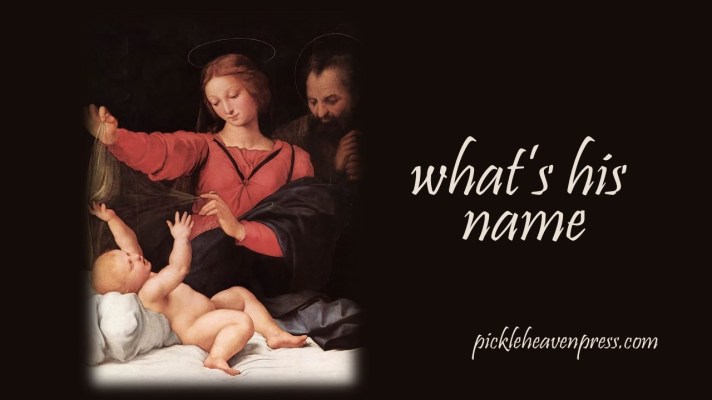
what’s his name?

I love a good last name.  In the old days they were derived from the family business – like Shoemaker, Potter or Baker.   I once had a job tending 2 llamas. Would this make me Jimmy Llama-Keeper?

People can be quite creative with the first names they give their babies. Some name them after consumer goods like Nike and Infiniti.  I considered naming our son Liquid Plumber but my wife did not approve.

Some 2,000 years ago there was a young couple in Bethlehem that needed to name their baby.  It had to be a good one, because a person’s name was extra significant in their culture. 

To the Hebrews, a name was not just a tool to distinguish a person.  It was regarded as the equivalent to the person themselves.   Their name signified their worth, character, reputation, authority, will, and ownership. 

In ancient Israel to speak in “the name of” signified authority (I Kings 21:8-10).    To forget someone’s name was to forsake them (Jeremiah 23:26-27.)   To act in someone’s name was to represent them (Deuteronomy 25:6).  To blot out someone’s name was to destroy them (Deuteronomy 9:14) and to believe in the name of a person was to trust them (John 1:12). 

Mary and Joseph had to choose a name that would fit their newborn child.  This would be tough because their child was not just another manchild.  He was the very Son of God, and the eternal Son of God has always had a name. 

In the Old Testament He was known as the Captain of the Lord of Hosts; the Star of Jacob; Adonai; the Rose of Sharon; the Scepter of Judah; the Lion of Judah; Wonderful Counselor; Almighty God; Everlasting Father; Prince of Peace; the Son of David and the list goes on easily containing a hundred or more rich names – each one adding honor and a new dimension of understanding of the Son of God.

But the day came that the Son of God took on human flesh. This called for a new name.  The angel Gabriel appeared to Mary the mother-to-be and said, “You will… give birth to a son, and you will name him Jesus – Luke 1:31.

The name “Jesus” meant “the one who saves.”  His name revealed His mission on this earth. 

Luke tells us when Jesus was given His name.  “At the end of eight days, when he was circumcised, he was named Jesus, the name given by the angel before he was conceived in the womb”-  Luke 2:21. It was the Jewish custom to postpone the naming of a male child until the day of His circumcision which took place 8 days after the day of his birth.  

This causes me to stand in even greater awe of my Savior.   When Christ became incarnate, He laid aside His rights and privileges as Deity.  He set aside the perks of being God.   The one who created the sea and the mountains would one day stumble up a hill called Calvary. 

He gave it all up – the power, the immunity from pain, the praise and adulation of the angels and eventually His very life.  But the one thing He was able to retain was His name.  He may have lost His privileges, but He was still somebody because He still had His name. 

And yet, He gave that up as well.  Eight days would elapse between the time of His birth and the time that His name would be officially bestowed. He existed 8 days without a name. He went from bearing the eternal title of Yahweh, to nameless obscurity.

Jesus gave up everything for us – everything – even His name.  He chose to be nameless, that we might be blameless. He gave it all up for us. 

So, what can we give to Him?  Perhaps this Christmas season we can remind our family and friends that Christmas is all about that baby boy who Joseph and Mary named Jesus.

A PRAYER: Lord thank you for giving it all up for me.  I praise Your most wonderful name!

This has been Jim Johnson and pickleheavenpress.com.

May the grace of our Lord Jesus be with you always.

Scripture passages are from the NETBible ®

christmas contemplations — December 17, 2025

christmas contemplations

I have a wearable device. The watch monitors my health.   It frequently sends me digital messages about my pulse and sleep and exercise.  The most recent message I received was, “Please report to the coroner.” 

That is what is known as a paradox – a self-contradictory statement or situation.  When it comes to the Christmas story – it is preposterously paradoxical.

Mary was pregnant and yet unwed.  And yet, what was perceived as sin in Mary was actually a mark of virtue.  The angel said to her, “Blessed art thou among women, and blessed is the fruit of thy womb” – Luke 1:42. (KJV)

Joseph traveled to Bethlehem, “in order to register along with Mary, who was engaged to him, and was with child.” – Luke 2:5. (NASB) Mary was with child, and yet – the child was with her.   His name was Immanuel which means, “God with us” (Matthew 1:22-23).

They were to register for the census (Luke 2:1-3).  The census was designed to count people, but while they were being counted – a child was born who would count more than any other. 

His future was to assume the throne of David and rule the earth.  Ironically the King of Rome (Caesar) called for the census that would validate Jesus as being of the lineage of David, and therefore legitimately in line to become the King of Israel (Matthew 1:1).

The infant was tightly wound in swaddling clothes (Luke 2:7). He was dressed in the same type of materials and in much the same way that He would be dressed for His burial.  

Mary dressed the baby, but in time the baby would dress her in His robes of righteousness (Romans 13:14).

The Psalmist wrote of the Lord, “Look! Israel’s Protector does not sleep or slumber” (Psalm 121:4). That was before God took on human flesh.  At Bethlehem He took His first nap snuggled in a manger (Luke 2:7).  

In the field, the shepherds were told by the angel to go to the child (Luke 2:12). Sheep were easily spooked so the shepherds tended to move in very slow and deliberate ways.   But, when the angel broke the news of the Son of God, Scripture says, “they made haste” (Luke 2:16).   

They tended the flocks that were being groomed to be sacrificial lambs in the temple nearby.  Little did they know they looked upon, “The Lamb of God who takes away the sins of the world“ (John 1:29).

The work of a shepherd caused him to be isolated from the rest of his community.   The folks who were typically the least to be considered and the last to know became the very first to know that the Savior of all men had been born. 

The law at that time forbade a shepherd from offering testimony in court of law and yet Luke 2:17-18 tells us they testified of more important things.  Luke wrote, “When they (the shepherds) saw him, they related what they had been told about this child, and all who heard it were astonished” NETBible ®

Christ, as pre-Incarnate God, illuminated the sky with stars (Genesis 1:16), and one of those stars shed its special light to guide the Magi to His side (Matthew 2:2).

The prophet Daniel said, “It is He (God) who changes the times and the epochs; He removes kings and establishes kings” – Daniel 2:21. – NASU   Christ, as pre incarnate God, sovereignly arranged to set up Herod as King to rule the nation of Israel. The Lord chose to elevate the man who tried to eliminate the Lord (Matthew 2:16-19). 

The shepherds joyfully shared the news of the birth while Herod repressed it (Matthew 2:7).

Of course, the most significant Christmas paradox is the incarnation itself.  Almighty God took on frail human flesh on Christmas day.  As man He became capable of giving His life for us.  As God His sacrifice would have eternal impact. 

Jesus is the prince of paradox!

A PRAYER: Lord, how marvelous You are.  We bless Your Holy name

This has been Jim Johnson and pickleheavenpress.com

May the grace of the Lord be with you, this Christmas and always