
Pickle Heaven Press-James R. Johnson

something to help you laugh and think about life with Christ

know thyself — March 22, 2026

know thyself

When I’m driving and I think of something I want to remember, I will record a voicemail on my phone and send it to myself.  The problem is, I do this so often that my email provider treats them as spam and blocks them from my inbox. 

How crazy is that – I am being blocked from communicating with myself.  Oh well I guess that’s better than unfriending myself. 

The truth is most of us are somewhat blocked from ourselves.  In other words, we choose to beware of being self-aware.  We don’t fully know who we are, and why we do what we do, and we are naïve as to how we impact others.   And truthfully, some of us don’t want to know. 

This was an issue that Jesus tackled in Luke 6.  He asked, “Why do you see the speck in your brother’s eye, but fail to see the beam of wood in your own? How can you say to your brother, ‘Brother, let me remove the speck from your eye,’ while you yourself don’t see the beam in your own? You hypocrite! – Luke 6:41-42.

Jesus created a comical word picture involving one person with a speck in his eye.  The Greek word for speck is “karphos” which could be a tiny piece of straw or wood.  

But then there was another person who was cursed with a beam in his eye.  The Greek word here is “dokos” which refers to the main beam that supports all the other beams in a roof structure.  The main beam suggests that it was a fundamental flaw in his life. 

Jesus focused on what they saw of each other, but what they failed to see in themselves.  Both were flawed, one a little and the other immensely, but both were blind to their own shortcomings.     

I’m reminded of a story I once read in Readers Digest.  Beatrice Rogers was waiting for her turn to enter the confessional at church.  She happened to hear the priest admonish the person ahead of her.  He said, “Please limit your confession to your own sins.”

As with Jesus’ story, we are probably blinded to ourselves a little or a lot and we need to do something about it.  Jesus said, “First remove the beam from your own eye, and then you can see clearly to remove the speck from your brother’s eye.”  – Luke 6:42.

So, what can we do to open our eyes to ourselves? 

Well, we can pray and ask God to open the eyes of our hearts.   David courageously prayed, “Search me, O God, and know my heart: try me, and know my thoughts” – Psalm 139:23. NASU

But the interesting thing In Jesus story, is that the beam guy was very aware of the failings of the speck guy.  So, what if they were to ask each other to share their observations?

My wife and I have done this for nearly fifty years now.  At bedtime, we pray with each other and read Scripture, but before we do, I ask her, “Have I done any badness today?” 

This is my way of asking her to help me understand how I have impacted her, so I can be a better me.  She answers, I seek her forgiveness and then she turns around and asks me the same question. 

This practice has fabulously helped us to open our eyes to the foolish and hurtful things we bring into our marriage and has made us far better spouses and people because of it.  

I will even occasionally ask my children to let me know if they see any hurtful way in me.

I took this practice to work with me as well.  Periodically I would ask my Elder Board to consider my preaching, and general pastoral ministry and make me aware of anything that might be hurtful.

So, take it from this guy with the beam in his eye.  Make an effort to, “Know Thyself.” 

A PRAYER: Lord, help us to know ourselves.

This has been Jim Johnson and pickleheavenpress.com

May the grace of our Lord Jesus be with you.

Scripture passages are from the NETBible® unless otherwise noted.
the 99 and 1 rule (reconciliation part 4) — November 10, 2021

the 99 and 1 rule (reconciliation part 4)

There is one question that a marriage counselor gets way more than any other, it’s this: “Would you fix my spouse?”

I guess we all tend to approach conflict in that way – we pin the donkey of blame on others rather than own it ourselves. 

The counsel of Jesus plays out differently.  He said, “Why do you see the speck in your brother’s eye, but fail to see the beam of wood in your own? How can you say to your brother, ‘Brother, let me remove the speck from your eye,’ while you yourself don’t see the beam in your own? You hypocrite! First remove the beam from your own eye, and then you can see clearly to remove the speck from your brother’s eye.”  (Luke 6:41-42) NET Bible ®

Jesus the carpenter knew the difference between a speck of sawdust and a two-by-four, and He used it to expose our silliness!  

When someone hurts us, we really want them to squirm and to own it.  We forget that we have added our own fuel to the fire and that our donation is much bigger – board sized, says Jesus.

Why is it that the Lord regards my problem as being bigger?  Maybe because not only am I guilty of my own offenses, I also brazenly assume the mantle of self-righteousness and become the judge of others.

Jesus tells us quite clearly to take care of our own problems first.

In the last post we looked at the need to approach conflict as a doctor.  Before doing surgery, a surgeon washes his hands and his arms with an antiseptic solution and then gloves up.  

If he performs surgery without being sterile, he contaminates the procedure, which could prove fatal in the outcome.   In the same way, Jesus tells us that we must be clean before we try to remove the cancer of conflict.

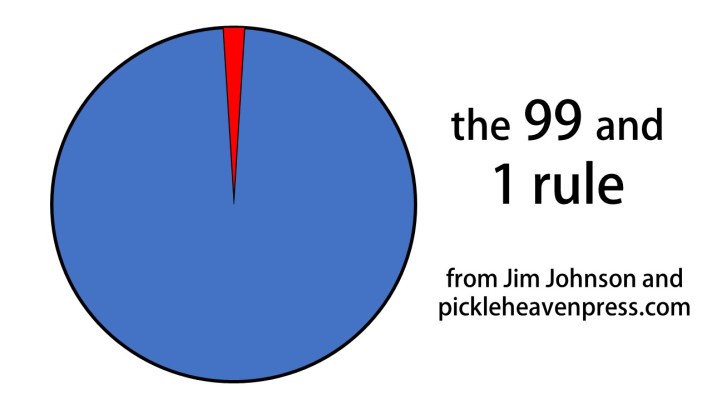
So, what is the 99 and 1 rule? 

In my 32 plus years in the ministry I have never witnessed a conflict where one person is 100% wrong and the other is 100% right.  Never have.  Each person usually has some responsibility in the mire and mess.  If it were possible to quantify it, it might be 70/30, or 50/50 or maybe even 99/1.  There is almost always blame on both sides. 

So, this is how I prefer to apply Jesus’ words. I look to myself first to see what I contributed to the problem.  Let’s suppose for the sake of illustration that it only amounts to 1%.  (I wish!)   That 1% seems like a speck, but even a speck, when it’s on your eyeball, seems bigger than a house.

And though the other person may be 99% guilty, instead of waiting for them to apologize, I take the initiative.  I go to them and say, “Hey, I was wrong when I _________.”   Would you please forgive me for that? 

Almost always the person immediately says yes to my humble request.  Forgiveness is granted.  And almost always they turn around and take responsibility for their 99%.   Sometimes the apology comes later, but it usually comes.

The conflict is over, and the good feelings flow once again. 

Is it right to admit you were wrong?  Absolutely!  Is it embarrassing?  Somewhat!  Is the embarrassment proportionate to your level of responsibility?  Not really.  Embarrassment is embarrassment!

So why not get the ball rolling by taking responsibility for your 1% or your 50% or your 99% or whatever it is?  Do your part to put the conflict to rest and bring peace.

So, what if they don’t respond like you might hope?  Doesn’t matter!  Jesus says it’s our duty to examine ourselves and take responsibility for our own offenses, not those of others.  And being in harmony with the Lord is probably the most rewarding peace of all.

A PRAYER: Lord I seldom want to own even my 1%.  Help me to recognize my contributions to the problem and be brave enough to admit it. 

This has been Jim Johnson with pickleheavenpress.com.  May the grace of our Lord Jesus be with you.