Pickle Heaven Press-James R. Johnson

something to help you laugh and think about life with Christ

presuming on the provision of God — March 12, 2024

presuming on the provision of God

When you need encouragement, you can’t necessarily count on a Bible scholar to give it!

I once had an opportunity to speak with a published professor from a Christian University. He seemed to take an interest in me, and asked what I thought my next step in life might be.   I told him that I was planning on studying at Dallas Theological Seminary where I would prepare to do ministry.

He immediately reacted , “How much money have you saved?”   This was not the kind of question I expected from a man of faith!

With embarrassment I told him, “$1,000.”  He shot back again with an authoritative tone, “Don’t go!  Don’t go until you have lots more saved!”   The implication was, “You won’t make it unless you go loaded.”

I began second guessing my goal.  The man had a doctorate in the ways of God.  He also had wallet wisdom.  He happened to be footing the bill for his son who was a student at DTS at that time.

Who was I to disregard his admonition – and yet – God put it in my heart to study there.  And I took His promise literally. “And my God will supply your every need according to his glorious riches in Christ Jesus.” – Philippians 4:19

In early August I gathered up my goods, my wife, two kids, and my thousand bucks and headed to Dallas. I didn’t have the money yet to pay for my first semester’s tuition or buy books or to rent an apartment.  BUT by the first day of class I did.

God miraculously provided.  And I continued to have what I needed before each term began.  I graduated on time with no debt.

So, here’s a question!  Did I presume upon the provision of God?  Did I make a decision which forced God to cover it.  I don’t believe I did.  He directed me to go to Seminary and I have learned that, “God funds what God wills.”

That money was necessary to do His will.  So, He supplied as promised.

Is it even possible to presume upon the provision of God?   It is! 

We presume upon the provision of God…

– when we go where God does not will. 

If He wanted me to stay home and be a plumber, He would not have made it financially possible to do Seminary.  God does not fund what God does not will.

– when we confuse our wants with needs. 

He promised to provide for our essential needs.  According to the Sermon on the Mount these needs are food, clothing and housing.  (Matthew 6)

– when we expect God will fund our every financial decision. 

         Let’s suppose that 80% of my budget goes to needs, and 10% to wants. (setting aside 10% for giving.)  But I decide to buy a bigger house with a much bigger mortgage payment.   

Is God then obligated to increase my income to fund that decision?  No! It means that now 88% of the budget will go to cover needs, leaving 2% to spend on wants. 

– when we cheat on God.

         The promise God made to the Philippians was premised on that fact that they were generous givers.  They supported the ministry of Paul to the point where they impoverished themselves. (Philippians 4:10-18)  

God does not require a tithe from the New Testament believer, but He does expect us to give.  Paul wrote, “Each one of you should give just as he has decided in his heart, not reluctantly or under compulsion, because God loves a cheerful giver.  (1 Corinthians 9:7)

It really is foolish to presume – like the time I naively asked one of our ladies at church when her baby was due.  Hey, take it easy on me.  Her top looked like maternity wear.

You, however, are much wiser – so be careful about presuming on the provision of God.   

A Prayer: Lord sometimes the distinction between faith and presumption is not clear to us.  Please give us the wisdom we need.

This has been Jim Johnson and pickleheavenpress.com

May the grace of our Lord Jesus be with you. 

Scripture passages are from the NETBible ®
the man at the urinal — February 26, 2020

the man at the urinal

Presumption may be the preeminent personal problem that perplexes us today.  Should I automatically assume that my wife is the one who dinged the car?   Can we really be so sure about the motive of that politician?   Is my coworker really able to look at a guy and know that he is an interior decorator?

The online dictionary defines presumption this way: It is supposing that something is the case, based on probability.  The situation may or may not be true – but we may nevertheless presume it is.

And you know what?  Presumption can hurt!

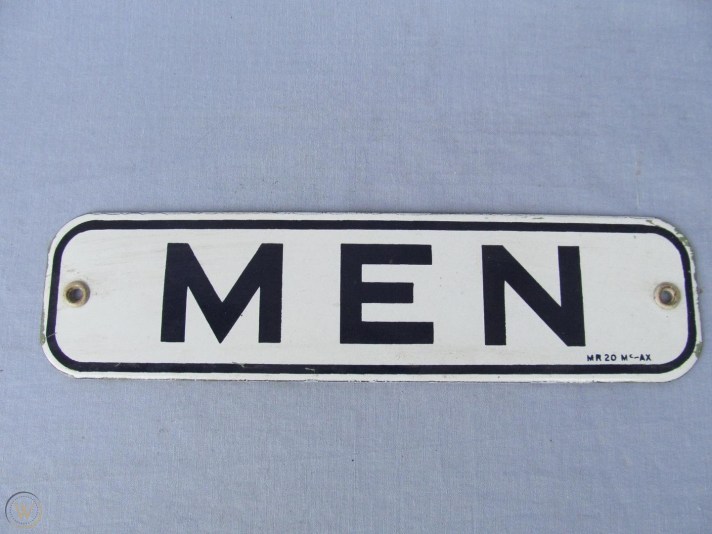
I am a grandpa and when I am in a public place with my grandsons, my daughter expects me to escort them when they go to the men’s room.  She is concerned for their safety.  I get that, but it can sometimes be embarrassing. 

One day he had to go – so I had to go.  He went into the stall, locked me out and sat down.  I leaned my back against the wall and settled in for a long winter’s nap.  It was just him and me. 

But then another man entered the bathroom and nervously looked my way.  I think I appeared to him to be loitering in the men’s room. 

And of course, my grandson couldn’t be seen.  So, the man used the urinal while I tried to figure out what to do.   Do I look up or down or sideways?   Do I whistle?  Do I talk to the guy?  No that would be creepy?

Meanwhile he kept looking back over his shoulder to make sure I hadn’t moved.  

And my grandson, well he must have fallen down the toilet.  He had been in there 8 minutes, which in bathroom time is like 8 years. 

How could I make it clear that I was waiting on my grandson?  Then it came to me.  I said to the boy, “Hey buddy – ya done yet?” 

But my little buddy said nothing.  You could hear a pin drop.  He was too embarrassed to respond.  I wanted to choke him.

Meanwhile the man who stood at one of three urinals, presumed I was talking to him.  “Hey buddy – ya done yet?” 

He froze and then finished up and sprinted out of the restroom – and didn’t even wash his hands. 

It’s just dumb to presume that something is the case before we have the facts. 

This truth echoes throughout the Scripture – from the Old to the New Testament.   Solomon wrote, “The one who gives an answer before he listens— that is his folly and his shame.”   – Proverbs 18:13. 

It is foolish and even shameful, he says, to argue a point, or to make a judgment or level an accusation until we have first gathered the facts by thoroughly listening to the person. 

James wrote in his epistle, “Understand this, my dear brothers and sisters! Let every person be quick to listen, slow to speak, slow to anger.”  – James 1:19

He first urged us to understand.  Why – because we mostly don’t.  We do not fully appreciate the need to be quick to listen and anxious to understand the facts, and then to cautiously answer.

Nicodemus the Pharisee went to bat for Jesus.  He said to his peers, “Our law doesn’t condemn a man unless it first hears from him and learns what he is doing, does it?” – John 7:51

It was a principle of the Jewish Law that the accused had the right to speak and fully explain himself before any judgment took place – a great policy for us as well

Maybe we should become askers instead of accusers.  “Honey I noticed a ding in the car, do you know anything about that?”  A much better approach than, “When did you mar my car?”  

I wish the man at the urinal would have asked me a question like, “Hey, how are you doing.”  It would have been so easy to say, “Pretty good, just waiting on my grandson.  He must be constipated.” 

OK TMI. But you get the idea.  

Bible references from the NET Bible ®