Pickle Heaven Press-James R. Johnson

something to help you laugh and think about life with Christ

O little town of Nazareth — December 18, 2024

O little town of Nazareth

John Glenn, the first man to orbit the earth was from Ohio.  Neil Armstrong, the first man to walk on the moon is also from Ohio.   Someone asked, “If Ohio is such a great place, why does everyone try to get as far away from it as possible?”

God took me from Ohio to Texas where He opened the doors to 32 years of pastoral ministry.   Did God intend for me to become a Texan?

Yes! Paul taught that God sovereignly determines such matters (Acts 17:26).  So, let’s consider Nazareth.  Jesus spent about 30 years of His incarnate existence in that town.  Why did God place Him there?

– It was the fulfillment of prophecy.

Matthew wrote of Joseph, “He came to a town called Nazareth and lived there. Then what had been spoken by the prophets was fulfilled, that Jesus would be called a Nazarene” – Matthew 2:23.   It was obviously important to God’s plan that Jesus be raised there.

– Jesus and Nazareth shared a similar character

Nazareth was an insignificant place.  To get there you would leave the bustling Jezreel Valley, climb a precipitous path to get to an overlook about 350 feet above the valley floor.  This was Nazareth, except you wouldn’t see it because it lay in a basin.

Scholars believe that Nazareth numbered only 100-150. If Jesus’ family was an average size (Mark 6:3) Then the village would have had somewhere between 11-15 families. 

Other towns in the region were known for their industry, academia, or their historical significance, but Nazareth had little to distinguish it – much like Jesus of whom Isaiah said, “He has no stately form or majesty That we should look upon Him, nor appearance that we should be attracted to Him – Isaiah 53:2.

– Jesus shared a similar reputation as Nazareth

In John 1:46 Nathanel asked, “Can any good thing come out of Nazareth?”  He gave voice to the opinion of many in those days.  People of Galilee were considered to be the equivalent of hillbillies. 

But nearby was a city with a worse reputation. Sepphoris was a wealthy secularized trade center. It was a town full of sinners  

Now here’s the thing, Joseph and Jesus were carpenters who lived in a tiny town.  To make a living it is almost certain that they used their skills to furnish the homes of Sepphoris. 

Some historians believe that this was the very reason that Nazareth existed – as a service town to Sepphoris.  So, it could be said that Nazareth was a town friendly to sinners as was Jesus.  Ironically, His critics called Him, “a friend of tax collectors and sinners!”  – Matthew 11:19.

– Nazareth provided a review of the past

From the overlook in Nazareth, you can see for 30 miles in 3 different directions.   The boy Jesus likely spent a lot of time there taking in the scenery. 

He would have been able to see places associated with Moses, Deborah, Barak, Joshua, David, Elijah and Elisha, Saul, Gideon, Josiah, and the Maccabees.  The view is said to be the most extensive available in Palestine.

God placed Jesus in a village with a panoramic view of the past to remind Him that He had been sent to complete God’s plan of redemption.

– Nazareth provided a preview of the future

At the end of the valley is the place known as Armageddon where the forces of evil will gather in the last days.  God will overthrow them, and Jesus will then return to the earth and bring history to its conclusion.   In Nazareth God planted in Jesus the vision of what lay ahead.

We are deeply imprinted by the culture in which we were raised. So how providential that Jesus was raised in a humble, common-sense place like Nazareth – a place where He would develop a profound appreciation for redemption history and anticipate its future culmination.

So why does God have you where you presently are?

A PRAYER: Why Lord do you have me where I am?

This has been Jim Johnson and pickleheavenpress.com

May the grace of our Lord be with you

Scripture references from the NETBible®
moving day — December 11, 2024

moving day

Soon after I moved to Texas, I learned to use a lasso. I was preparing in case there was a citizenship test.  I mastered putting the noose around a fence post, so it was time to try it on a calf.

There he was in the pasture, munching on some grass, when I whipped that rope past my head and over his.  He began mooing for his momma and she quickly showed up with several of her irate bovine buddies and I ran for cover.

It took nearly an hour and a barrage of cow pies to get my rope back. 

I didn’t think I could rope a real calf.  I guess I had more potential than I thought.

It reminds me of the story in Mark 11. “In the morning as they passed by, they saw the fig tree withered from the roots. Peter remembered and said to him, “Rabbi, look! The fig tree you cursed has withered.” Jesus said to them, “Have faith in God. I tell you the truth, if someone says to this mountain, ‘Be lifted up and thrown into the sea,’ and does not doubt in his heart but believes that what he says will happen, it will be done for him.”  – Mark 11:20-23 – NETBible ®

Jesus cursed a tree the day before, and it withered in response.  He told Peter, however, that even greater things could be done by those who believe.  A mountain could be moved by faith. 

Now to my knowledge the faithful through the ages have not moved any mountains – at least not yet. 

On the other hand, maybe the failure has to do with our flawed faith, rather than His dependable promises.   No mountains have been moved yet, but God has moved other great things in response to the faith of His people. 

Way back in the eighteen hundreds, there was a small group of Methodists living in Swan Quarter, North Carolina.  They believed they needed their own building to grow the church.   The need was bathed in faith-filled prayer. 

They identified the perfect lot for the church location.  It was owned by Mr. Samuel Sadler.  But Sadler sadly refused to do business with them.  He would not give, lease or sell the property to the church.

So, they settled on a lot that was on the banks of Oyster Creek.  It was low lying property and far from ideal, but they made do.  They completed their one room white frame building on Sept. 16th, 1876. 

Then three days later the town was lashed by a hurricane that left it under 5 feet of water.  The water lifted the wooden church building off its brick foundation and it began to float.  It moved northward up Oyster Creek St.

The townsfolk saw it and sloshed through the water trying to lasso it but to no avail.  The church building floated to the center of the town and then for no apparent reason took a right turn on Main St. as if it had a mind of its own. 

It drifted for two more blocks and then again veered without explanation off to the left side of the road to a vacant lot – and there it stopped.  And that lot – was Samuel Sadler’s lot – the one they had tried to buy

The next day Sadler knocked on the door of the Methodist minister’s home and with trembling hands, presented him with the deed to the lot. 

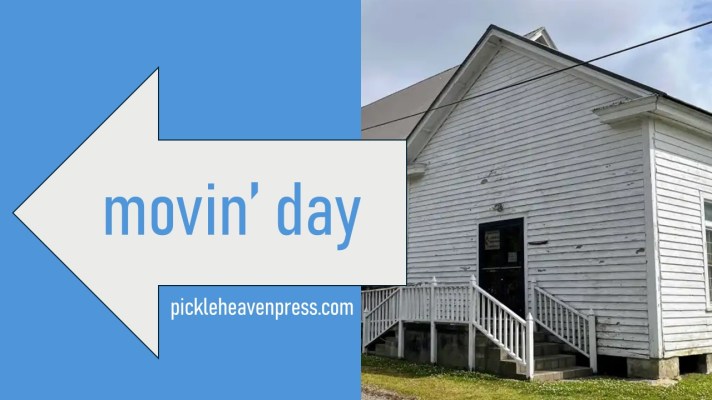
The brick building in the attached picture is the newer building, the white one is the original building moved by the hand of God.  Both are still in use.   Oh, and by the way, they appropriately named the church – Providence Methodist Church. 

The mountain you need to have moved, may be even greater: a child with an addiction; a spouse with cancer; downsizing at work; or maybe an insufficient income.  

Pray – believing that God is for you and will be there for you.  He still moves mountains and church buildings.  

A PRAYER: Lord, we believe.  Help our unbelief (Mark 9:24).

This has been Jim Johnson and pickleheavenpress.com

May the grace of our Lord be with you

honor rolling — January 31, 2024

honor rolling

General Rommel, also known as the Desert Fox, surrendered his famous German Afrika Corp in WWII.  150,000 men were taken prisoner at that time and transported to the U.S.

The Geneva Convention required that prisoners of war be moved to a climate similar to the one where they were captured.  Somebody figured that the Sahara and Texas have a lot in common – so they shipped them all to the Lone Star State.

There were 200 of them quartered at General Harmon Hospital in Longview, Texas (now the campus of LeTourneau University).  They served there as hospital orderlies.

With only minimal security the prisoners were able to sneak out of camp and wander into the surrounding neighborhood.  Fortunately, the community around the hospital was uncommonly hospitable. 

My friend Jim Armstrong was a child, living in Longview during the war.  This is what he remembers.

A prisoner politely knocked on the door.  The Mrs. appeared and was flabbergasted and intimidated.   The prison garb revealed who the man was and where he belonged. 

He didn’t know English, so he gestured, moving his hand to his mouth several times.  He seemed to be asking for food.   This was puzzling!  He was fed well at the hospital.  In fact, the locals called the place, “The Fritz Ritz.”   

But the man was evidently tired of – all the mess – at the mess hall.  He longed for a tasty, lovingly crafted, homemade meal.  Well, she was a Christian and felt it was her duty to provide it.

So, he was invited in to dine with the family.   After dinner he expressed his appreciation by clicking his heels, bowing, and saying Donke Shoen – and then he left to slip back into camp.

This happened multiple times with a number of Longview families. 

Ironically, most of those families had menfolk who at that very time were risking their lives in Europe to stop the Germans in their world conquest.  Yet the folks back home looked upon those German men with compassion and invited them in. They honored their enemies!  

This reminds me of the words the Lord gave us in 1 Peter 2:17. He said, “Honor all people…”  NET Bible ®

I initially read that, and my mind scrambled to explain it away – because – well, I didn’t like it.    It seemed to say that a Christian is obligated to honor and respect all people.

The problem must be in the translation.  Maybe I should look at the New American Standard.  Hmm it says, “Honor all people.”  What about the NIV, “Show proper respect to everyone.”   Well certainly, the old King James will get it right.  Oops – it says, “Honour all men.”  KJV

Surely this cannot include that guy whose vote cancels out mine on election day!  It must not apply to those whose moral values I question.  I just know it can’t be speaking of those who despise me because of my faith. 

Yes, the Scripture tells me that I am to honor even those.  There is no getting around it.  The believer ought to make every effort to respect and honor every person.

But why? Probably because we are all created in the image of God.  We bear His likeness.  We are interrelated as family – sharing the same divine DNA.

And you know, thinking in terms of family, makes it seem doable. Most of us have learned to tolerate and get along with sullen siblings and combative cousins and such who may challenge us. 

We may disagree on politics, or religion, or schooling philosophy or even our favorite singer on The Voice.  And yet we make a super extra effort to get along and to honor them simply because they are family.

Unfortunately – we dwell in a culture where civility has become a casualty and respect is disrespected!   It hasn’t always been and isn’t fated to always be.  And by God’s grace maybe we can do our part to get the honor rolling!

A PRAYER: Lord this is a tough one.  Help us get tough and do it.

This has been Jim Johnson and pickleheavenpress.com

May the grace of our Lord Jesus be with you.

makin’ it simple — April 3, 2023

makin’ it simple

It’s not often that I am thankful for speed limits.  Today I am – because they are simple and standardized.  I mean what if speed limits reflected regional values instead. 

The black and white sign in Texas may say, “Hold your horses, boy.” The speed posted in Pennsylvania Amish country might be, “Keep thine buggy under 15.” In Nevada it may say, “Roll the Dice.”

And what about the legislative loonies in New York?  They might regulate the speed to the decimal level.  “Speed Limit 27.26.”  Unless it’s open country – then it’s 36.79 which lowers one tenth a mph. every ¾ of a mile as it approaches a town. 

The variations and complexity of posted speeds could end up being enormous and impossible.   

What a fun time my wife and I would have as we made that drive. “Jim, you are going 2 one hundredths over the speed limit.  Just look at the speedometer.”    “Uh OK, could you hand me a magnifying glass?”  

Then a yellow sign says, “Men working-reduce your speed by 35%.”  “Uh, Siri what is 35% of 36.79?” 

And if I get pulled over?  “Sir do you know how fast you were going?  “No officer, I am bad with math.”

We need clarity and simplicity when it comes to what is expected of us.

I imagine that is why Jesus helped us out in Matthew 22.

He was being accosted by the religious experts of His day, who were trying to trip Him up with legal trivia.  That is when this happened, “And one of them, an expert in religious law, asked him a question to test him: “Teacher, which commandment in the law is the greatest?”  (22:35-36)

A fair question, long debated by the Jewish people.  The specific Old Testament laws that they received from God numbered 613.  How could anyone hope to understand and do them all? 

So, the “experts” conveniently divided them up into “heavy” laws which they deemed most important, and “light” laws which were not.  Folks were expected to obey the heavy ones and not worry about the light. 

If Jesus were to cite one specific law from among the 613, the experts would indict Him for being dismissive of the rest. 

So, He replied, “‘Love the Lord your God with all your heart, with all your soul, and with all your mind.’ This is the first and greatest commandment.  (22:37-38)

Brilliant!  He cited the “great Shema” of Israel, from Deuteronomy 6:4-5.  This statement of faith was recited daily by every orthodox Jew.  It was simple and comprehensive.  Love the Lord your God with everything you got.  One law that called for complete surrender and devotion to the Lord.    

But then He added something unexpected from Leviticus 19:18 – words that were not recited by the Jews every day.  He said, “The second is like it: ‘Love your neighbor as yourself.’  (22:39)   

The common denominator in both is the word “love.”  It calls for a heart obedience to the law.  To love God and to love those created in His image.  Both are necessary.  Even the apostle John echoed the same truth (1 John 4:20)

Jesus wrapped it up by saying, “All the law and the prophets depend on these two commandments.”  (22:40) This is to say that the entire 613 laws and the rest of the Old Testament are all more specific expressions of these two comprehensive commandments.

This two-part summary covers the ten commandments to be sure.  The first of the 3 relate to our duty to God and the last 7 to our fellow man. 

So, when we drive down the road of life, and we are not completely clear about the speed limit – we should default to love.  “How can I best demonstrate love for my Lord in this situation?”  and “How can I love the person beside me in a way that will bring the greatest benefit to them?”

A PRAYER: Thank’s Lord for such a sweet summary of your expectations for us.

This has been Jim Johnson and pickleheavenpress.com

May the grace of our Lord Jesus be with you. 

Scripture references are from the NETBible ®

I just knowd it! — February 8, 2023

I just knowd it!

I recently had a guy ask me a perplexing question: “Hey are you from Louisiana?”  “What!”  I asked, “Why you say dat?”

I concede that my accent is hard to figure.  I am an Ohioan who has lived in Texas for 40 years.  When I return to Ohio, and they get all rankled when I refer to them as, “ya’ll” and they wag their heads when I say “I knowd he et my “chicken fried steak.”   And they are relieved when I get in the car and say, “I’m fixin’ to go to the house.”

But when a Texan hears me speak, he says, “Where you from boy?”   When I ask for a bottle of pop – he wants to pop me. 

My accent may defy description – but Louisiana?  Makes me madder than a crawfish without a bayou!

Oh well, ultimately, it’s not where you are from that matters, but where you are going!

Where are we going?   Time moves forward whether we like it or not, and it sweeps us along with it.  So, what is our destination?  

Do we ever get in the car and say, “I don’t know where I’m going!”  OK sometimes I say that but that’s because I am old.  But, generally speaking, we don’t turn the key without having a destination in mind. 

The apostle John provided a helpful map for one particular spot.

He was writing to his spiritual “children” – those people that he had mentored and loved. In his letter, he taught them about Jesus and the faith, and how to love one another, and other themes that help a Christian understand how to live.

As he wound down his letter, he added this amazing gem of truth.  He wrote, “I have written these things to you who believe in the name of the Son of God so that you may know that you have eternal life.”  – 1 John 5:13

Now let’s make sure we get this.  He started with “I have written these things….”  What things?  All the spiritually affirming truths in chapters 1 through 5.

It was directed to “…you who believe in the name of the Son of God….”  He was addressing those who had placed their faith in Jesus as their Savior.   They were not relying on their own efforts or merit.  Their confidence wasn’t based on their church membership or attendance.  They relied solely on what Jesus had accomplished for them at the cross. 

His purpose was revealed in the last phrase, “…that you may know that you have eternal life.”  It isn’t always that you find the words “know” and “eternal life” in the same sentence.  And yet John says that the one who had put their hope in Christ has eternal life, and they can know and be assured of it in this life. 

Some might say, “Well, No one knows what know means.”

I get you.  Someone may say, “I know Fred.”  But in reality, Fred is more of an acquaintance to that person.  They don’t really and truly know him.  There is a word for that kind of knowing in the Greek New Testament.  It is “ginosko.” 

But John uses a very different word in his letter.  It is “oida” which refers to a deep, full, true understanding of a person or an issue.  This is a convinced kind of knowing. 

So, John tells us that the person who has trusted Christ should have a deep down, in the pit of their stomach, sure as shootin’ assurance that heaven is in their future.

Ultimately, it’s not where you are from that matters, but where you are going!  If you have trusted Jesus – you are going to heaven!  I just knowd it.

A PRAYER: Thank you God for helping me truly and deeply know that I will be with you when this life has been exhausted.

This has been Jim Johnson and pickleheavenpress.com

May the grace of our Lord Jesus be with you.

an amerasian story — February 1, 2023

an amerasian story

“Pure and undefiled religion before God the Father is this: to care for orphans and widows in their adversity.”  – James 1:27-  NETBible.com

I have sometimes wondered what this would look like today – and then I met Amber.

We were sitting at the bedside of her mother Sarah who was nearing her earthly journey’s end.  Amber was eager to tell me her story. 

Sarah was once a vibrant single woman – a successful advertising sales rep.  She was also devoted to Jesus and loved to sing His praises in the church choir.  But she wanted more – a family. 

Marriage didn’t seem to be a part of God’s plan for Sarah, but a child – well maybe!  So it was, that she was watching a news program on TV one day and learned about what they called Amerasian children. 

These are the children begotten of reckless American service men and young, hopeful, Asian women.  A child is born, the GI ships out, and the unwed mother is left with a child that her culture abhors.  “Most never knew their fathers. Many were abandoned by their mothers at the gates of orphanages. Some were discarded in garbage cans. Schoolmates taunted and pummeled them and mocked them Their destiny was to become waifs and beggars, living in the streets and parks.”  In Vietnam they were called “children of dust.”  (Smithsonian Magazine – https://www.smithsonianmag.com/travel/children-of-the-vietnam-war-131207347/

Sarah decided that this was exactly the kind of child that needed her love.  But she ran into some ridiculous red tape.  At that time, a single woman in the U.S. was not permitted to adopt an international child. 

Sarah refused to take no for an answer.  That Texas girl dug in her heels, and set up camp in Washington D.C.  She went – office to office, Representative to Representative, Senator to Senator, pleading with someone to take up her case. 

After two intense months of this kind of lobbying, one Senator finally offered to help.  He sponsored a bill that was passed which gave Sarah and other singles like her a greenlight to adopt an international child. 

In the meantime, there was a special little Amerasian girl in South Korea.  She was about five years old, living in an orphanage in the midst of a culture that wished her to disappear.  Her prospects of adoption were growing less by the year. 

But Sarah found her and loved her and brought her home to Texas.   Amber doesn’t remember anything of Korea, but she does recall her first trip on an airplane and arriving at DFW where she was met by a throng of lights and cameras and eager reporters who were there to cover this amazing story. 

Amber was so proud of and grateful to her mother. 

As for Sarah, she wasn’t able to speak to me as we sat in her room in those twilight hours, but her life story said it all.  Here was a woman whose courageous Christian faith motivated her to do what few of the rest of us would attempt.  Thank you, Sarah, for showing us how it’s done.

A PRAYER: God gives us all hearts as tender and tenacious as Sarah’s.

This has been Jim Johnson and pickleheavenpress.com

May the grace of our Lord Jesus be with you.

filled — August 17, 2022

filled

It was another blistering Texas day, and yet the lawn still cried for attention.  I filled the mower with gas and began to pursue the endless loop.  Soon after, I noticed that I had failed to screw down the cap to the tank on the mower. 

I found that 90% of the fuel had sloshed out and I was running low.  Now I may have to cash in my IRA to buy more gas.

So, I queried, “Why Lord?” and He said, “Because thou art a dummy!’  That’s what He should have said, but He had a lesson for me instead.

He said, “Do you remember back to when you first surrendered to Me?  I in turn filled you with my Holy Spirit so that you were empowered to accomplish great things for Me.  But you have made a few choices since then that have loosened your spiritual cap, and like your mower, you have been leaking.”

Goofy story – but good theology.

The Holy Spirit is that third person of the Trinity that we cannot do without.  At salvation, we are baptized in, indwelt by, and sealed with the Holy Spirit.   This is God’s unconditional provision for every believer.

To be filled with the Spirit is to submit to His gentle control.  To be filled is to be fruitful.  We manifest in our character qualities like love, joy, peace, patience, kindness, goodness, faithfulness, gentleness, and self-control.  (Galatians 5:22)  

When it comes to this filling, we determine to what degree we are filled by the measure of our willingness to submit.  In fact, Paul wrote as a command, “Be filled by the Spirit.”  – Ephesians 5:18

The verb “be filled” is a present imperative meaning, “be continually filled.”   It is something that should be repeated as frequently as needed. 

Why repeat it?  Because there really are circumstances that loosen our spiritual cap and result in leakage. 

In Ephesians 4:30 Paul said, “Do not grieve the Holy Spirit.”  The context of this passage relates to problems with sin.  Sin is rebellion which is the flip side of submission, and it grieves God.  The freedom of the Spirit to work in and through us is diminished by it.

Not hard to understand.  Tom prayed for patience with his boss. The Holy Spirit delivered when Tom held his tongue during staff meeting.  It was a wondrous spirit filled moment. 

Thirty minutes later his wife called and asked if he had taken out the trash.  He said, “I didn’t have time.”  But he lied.  He wronged his wife and grieved the Spirit.  

It is also possible to “quench” the Spirit. (1 Thessalonians 5:19) The context has to do with resistance to doing our service to the Lord.   God gave His Spirit, in part, to empower us to do ministry.  When we resist, we throw cold water on the promptings of the Spirit.

In both instances, choices were made that resisted the work of the Holy Spirit.  Once filled, then deflated. 

It’s ironic.  The Holy Spirt as God is omnipresent and fills everything, and yet we human beings make it so that we can be less than filled.  A mystery for sure.   


We are never commanded to pray for this filling.  It has already been provided.  To enjoy it we need to confess any sin and invite the Lord to reassume His gracious control.

I am glad that my cell phone indicates to what degree my phone battery is charged.  Wouldn’t it be nice to have that feature in our walk with God? – something to tell us, to what degree we are filled and controlled by the Holy Spirit. 

Maybe the next best thing, would be to start each day with the assumption we need to be filled again.  

We might reflect it in a prayer.   “Lord, my will is to do your will.  I empty myself of my personal ambitions and ego indulgences and I welcome You to guide me through this day.  Please tenderize my heart to the nudging of your Holy Spirit. 

This has been Jim Johnson and pickleheavenpress.com

May the grace of our Lord Jesus be with you.

Scripture passages are from the NET Bible ®

meetin’ the in-laws — September 9, 2020

meetin’ the in-laws

Our sweet little Texas daughter was engaged to a fine young man from British Columbia (which is in Canada for those of you who slept through geography).   

It would be a merging of families and cultures.  She was “fixin” to get married and he said in, “a bit.” 

His family arrived in our little Texas town for the wedding just a couple of days before.  We had not yet met them, but we knew they were fascinated with the aura of Texas (and who isn’t?)  So, I decided they should get a rootin’ tootin’ redneck reception. 

I borrowed me some well-worn cowboys boots and slipped on some jeans helt up with a belt and big old buckle.  I snapped up a pearl buttoned, cowboy-cut shirt and dropped a round tin of Skoal in the pocket.  I finished off my western ensemble with an audacious cowboy hat. 

We then went to meet our new family.  My daughter and her beau were with them already and very excited about this first meeting.  I rapped on the front door and it was opened by her future mother-in-law. 

I conjured up a Texas drawl and said, “Well howdy Maam!”  She was speechless – but my daughter wasn’t.  She heard the knock at the door and came running down the stairs to see – took one look at me and screamed the loudest longest screech ever, “Daaaaaaaaaaaaaaaad!”

                                                   ———————-

Sometimes it’s fun to pretend and actually, I’m pretty good at it.

Not only can I do a redneck, I can also create the impression that I have everything under control when in fact I am paralyzed with fear.  My lips have learned the art of saying yes to every request while the rest of me cringes.  Some pretend to care by asking me, “How are you doing?”  I pretend right back and say “fine.”

I am thinking that Paul may have written Ephesians 4:25 for me.  He said, “Therefore, having laid aside falsehood, each one of you speak the truth with his neighbor because we are members of one another.”  NET Bible ®

He said to lay aside “falsehood.“  The word is translated from the Greek word, “psuedos.”  Yep that is where we get the English prefix “pseudo.”   He is talking about fakes.  It refers to deceit whether it be through what we say or portray.

Paul says this “psuedos” needs to be laid aside.  In other words, stop pretending.  Drop the mask (unless it is an N95 and you are Covid positive.)

Instead, Paul tells us to accurately reflect in words what is true because we are all members of one another – we belong to each other.

Why do I pretend that everything is under control?  Why can’t I tell the boss I could use a little help?   Is it my pride – the stuff that goeth before a fall? 

Why do I feel the need to say yes to every ask?  Do I not have my limits?  The pastor asked me to teach a class on marriage.  What if I were to be honest and showed him my crowded calendar.  I bet he’d send me home to work on my marriage.

Why must I reply “fine” to everyone who asks about my welfare?  A friend may be genuinely interested in how I am doing.  If he got a truthful answer, he might take a knee and pray right then. That would be nice!

Jesus once said that the truth will set us free.  He was speaking of freedom from sin and its consequences, but beyond that, there is true liberation and a sense of rest that comes from living genuinely and speaking truthfully. 

Yes, I need to consider the timing and the spirit in which I engage – but generally speaking: “Honesty really is the best policy.”

I have retired my western duds.   My Canadian family knows I am about as cowboy as bacon without the sizzle.   Now it’s time to remove the pretense from the rest of my life.  Will you join me? 

A PRAYER: Lord let me enjoy the freedom that is created by living in and speaking forth the truth.

the 11th plague — March 4, 2020

the 11th plague

We were driving back to Texas when a plague of biblical proportion swept into the open windows and defiled our car.

The family was exhausted from our trip.  The long drive home was even more taxing.  The plan was to stop and overnight soon.

But, just west of Birmingham, we were overcome by a heavy putrid stench.  We had never smelled this sickening smell before.  What was it?  Was an Alabamian boiling peanuts?

We closed the windows and turned on the AC.  Didn’t help!   We asked the boys to change their socks. Didn’t help.  We tried breathing through our mouths.  It tasted as bad as it smelled.

Rather than stopping, we decided to drive on until we got beyond the stench.   BUT it still oppressed us in Bessemer, and then Tuscaloosa, and into Toomsuba, Mississippi. 

And there was despair in the car.  For three hours we had been in the grips of the stench.  My daughter was turning blue. 

Somewhere just east of Jackson, MS, I tried to pass a tractor-trailer and what I saw on the open air trailer was ghastly.  The trailer had legs and hooves popping out of it in every direction.  It looked like one big, disgusting stockyard pin cushion. 

The truck must have been headed to a rendering plant, where the barnyard bereaved would be recycled into useful household products.  There is a reason why there is a cow on your bottle of Elmer’s Glue? 

And we had followed in the stinking wake of that truck for 3 hours. 

I stomped on the gas and sped past it and we sailed into sweet, wonderful, fresh air.  Forget the motel.  There was no way I was gonna let that truck get in front of me again.  

The truck left behind a stench.  Some people do that too! 

There is the girl at school who always seems to be walking away from a conflict or the guy that has wrecked four marriages and is now is on his fifth.  There is a stench of sorts that the angry dad leaves behind for his kids.  And what the about the boss who loses employees faster than he can hire new?   Then there is that woman at church who leaves people feeling like they have been to court and lost.

It shouldn’t be that way!

In the 23rd Psalm David taught us that sheep who follow their shepherd are fed, watered, restored, directed and protected. 

But then the Psalm winds up in a curious way.  David wrote, “Surely goodness and mercy shall follow me all the days of my life.” (vs. 6)  NET Bible ®  

In other words: David left behind a sweetness instead of a stench. 

Phillip Keller in his book, A Shepherd Looks at the 23rd Psalm, explained that sheep can enhance the quality of a pasture.  They eat noxious weeds that would otherwise choke out the good and they fertilize the soil as well.  He wrote, “In a few years, a flock of well managed sheep will clean up and restore a piece of ravaged land as no other creature can do.”  (pg 131) 

David understood this and applied it to himself as a sheep.  As he followed the lead of his Shepherd, it impacted the way he treated others. 

His nation celebrated his righteous leadership.  The son of Saul was grateful for David’s mercy.  The army that faced Goliath was inspired by his faith.  David’s followers were moved by his transparency and humility.  He was the kind of man you wanted to follow because he sweetened the pasture for those who did.

Are you leaving a sweetness or a stench?  Stop!  Turn around!  Look at the people you just left.  Make sure they are wearing a smile instead of a sneer!