Pickle Heaven Press-James R. Johnson

something to help you laugh and think about life with Christ

uncommon sense — May 27, 2026

uncommon sense

It is uncommon to have common sense.

There was a goodhearted guy who volunteered to serve in the church bus ministry.   He was out solo, learning to drive when the bus stalled in the middle of an intersection.  I pulled over to help. 

It rested on a level spot in the middle of a hill.  I suggested that we push it off center and get it rolling down the hill.  He pointed up the hill and said, “But I want to go there!”  I said to myself, “In your dreams!”

I offered to push from the back while he pushed on the passenger side next to the door of the bus.  If we could get it rolling, he could then jump in and take the wheel and steer it. He agreed.

I pushed and the bus began to rock, when suddenly he joined me on the driver’s side.  I said, “Hey if this thing starts rolling, whose gonna guide it? 

A guy pulled up in a pickup and offered to tow it.  He told the bus driver to put it in neutral and then steer it as it was pulled.  The bus driver got behind the wheel and gave the thumbs up sign. 

The pickup driver gave it the gas and his tires spun furiously in place.  The bus was still in gear, so I slipped away at that point, very much afraid for my life.

The bus driver was a common-sense casualty!     

Can a person address common sense deficiencies?  Sure!  We can learn from parents, or “how to” books, youtube videos and life experiences.  They all have much to teach.

But the best, most comprehensive resource is the book of Proverbs.   The book was written by Solomon in order to teach his son how to live wisely.   Here is a sampling of his sage advice. 

– DEBT: “The rich rule over the poor, and the borrower is servant to the lender” (22:7).  Solomon tells us that the debt we incur steals our freedom and makes us slaves to those we owe.

– CONFLICT: Starting a quarrel is like letting out water; abandon strife before it breaks out!” (17:14).  Resolving a conflict is harder than gathering up spilled water.  Best to manage it beforehand.  

– SPEECH: “A gentle response turns away anger, but a harsh word stirs up wrath” (15:1).  Careful, gentle words are always the best especially in a time of conflict. 

– WORK: “In all hard work there is profit, but merely talking about it only brings poverty”  (14:23). Proverbs has much to say about how we work, and the benefits that come from it.

– DISHONEST GAIN: “Stolen waters are sweet, and food obtained in secret is pleasant!”  But they do not realize that the dead are there, that her guests are in the depths of the grave” (9:17-18).  Solomon honestly discloses the temporary benefits of dishonest gain, but also the enduring consequences. 

– TEMPER: “Like a city that is broken down and without a wall, so is a person who cannot control his temper” (25:28). Solomon should have posted my picture next to this one.  This was once a big problem for me, fortunately much better now because I have digested such Proverbs.

– SAVINGS: “Go to the ant, you sluggard; observe her ways and be wise!  It has no commander, overseer, or ruler, yet it would prepare its food in the summer; it gathered at the harvest what it will eat” (6:6-8).  Saving for the future is always wise.

– FRIENDS: ”There are companions who harm one another, but there is a friend who sticks closer than a brother” (18:24).  Loyalty is a hallmark of friendship

Proverbs is bursting with everyday practical wisdom.  Read one of the 31 chapters each day for a good infusion of common sense. 

Is there an appropriate Proverb for my bus driver buddy?  How about this.  “It is dangerous to have zeal without knowledge, and the one who acts hastily makes poor choices.” (19:2) Amen!

A PRAYER: Oh God, help me in my foolishess.

This has been Jim Johnson and pickleheavenpress.com

May the grace of our Lord Jesus be with you always.

Scripture passages are from the NETBible®

bluebell and the blues — May 7, 2025

bluebell and the blues

Solomon once wrote, “There is nothing better for people than to eat and drink…” – Ecclesiastes 2:24.  So what did he think was so great to eat?  Dates and figs?  I don’t know, but, if he were alive today, he might revise his words to say, “There is nothing better for people than to eat ice cream, especially Bluebell.”  Amen!

OK – maybe we need to back up and understand the context of Solomon’s words.  The brutally honest book of Ecclesiastes was written to help us live meaningful lives.

He argued that many of us strive our way through life, and this striving is folly.  Some labor to be rich, but are never able to enjoy their money (5:10-12); Some wrangle their way to fame, and yet the humble still seem to outshine them (10:6-7).

Others strive to have power and yet the very powerful king of Israel went on record saying, “Vanity of vanities; all is vanity.”  (1:2) Some strive for security, but Solomon reminds us that naked we came, and naked we will go. (5:15)

And then there are some that are obsessed with our health and long life, but Solomon said, “youth and the prime of life are fleeting.” (11:10)  He often emphasized the fact that we are all gonna die (5:16). 

He sums up all our striving with the word, “vanity,” which he repeated 38 times in the book.  All is vanity

When we strive for things that we never really obtain, it is a pointless, painful experience.  Even when we do obtain them, we are stunned by the pointlessness of it all.

I was voted senior class president in high school.  I was jubilant for a day or two until I found out that honor was outweighed by the onerous responsibility.

Now before you look for Xanax, you need to know that Solomon was not depressed.  He was quite upbeat and hopeful.  The one word Solomon used in his book more than the word vanity, is God (40 times).

He tells us to consider God’s works (7:13)  to listen to His words (5:1) to fear Him (5:7) to please Him (7:26) and to remember him (12:1)   He described life “under the sun” as vanity (4:7), but He knew that we are headed to that place above the sun, in the presence of God where hope abounds (12:6-8).

Which means that the person who is rightly related to the Lord can cease to strive and enjoy being alive.  In fact, we should strive less and savor more the blessings He gives.

He encourages us to enjoy our mate (9:9), food and drink (5:18) and every fruit of our labor (5:19) When God has the proper place in our lives, we are free to do that.  

He put it this way in his book, “What does a man acquire from all his labor and from the anxiety that accompanies his toil on earth?   For all day long his work produces pain and frustration, and even at night his mind cannot relax.  This also is futile!  “There is nothing better for people than to eat and drink, and to find enjoyment in their work.  I also perceived that this ability to find enjoyment comes from God. For no one can eat and drink or experience joy apart from him.”  (2:22-25)

I am embarrassed by the phrase, “and even at night his mind cannot relax.”   It has been my experience much too often. 

What took Solomon a whole book to say, the apostle Paul said in one sentence “Command those who are rich in this world’s goods not to be haughty or to set their hope on riches, which are uncertain, but on God who richly provides us with all things for our enjoyment.” –  1 Timothy  6:17

So, strive less, serve the Lord more and savor the blessings He gives.  Seriously, it is impossible to wear a frown while enjoying a bowl of Bluebell.  

A PRAYER: Lord, I need your help in this area!  Help me to rest in You!

This has been Jim Johnson and pickleheavenpress.com

May the grace of our Lord Jesus be with you

Scripture passages are from the NETBible ® 

firewood folly — June 10, 2020

firewood folly

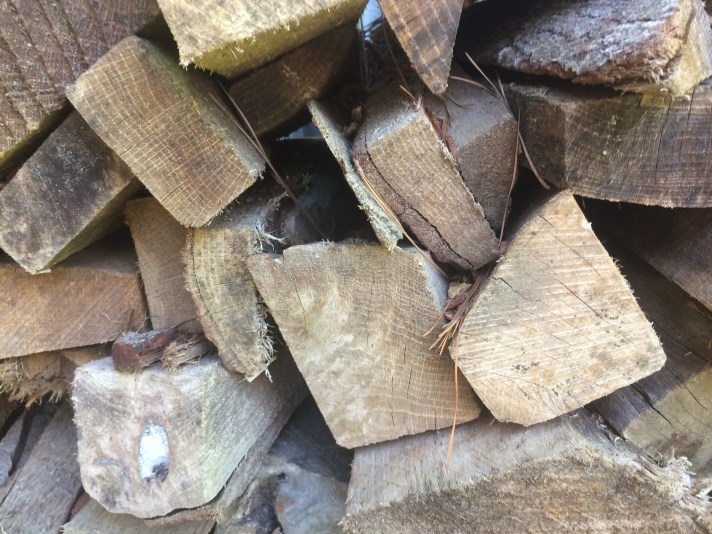
I have a grandson who is a budding entrepreneur.  His daddy brought down a tree in the front yard and then reduced the trunk to firewood.   

The boy seized the opportunity.  He took a cardboard box and made himself a sandwich sign.  He draped it over his shoulders and paraded around the neighborhood hoping to retail some of his fireplace fuel.  The sign said, “FRESH FIREWOOD.” 

I so laughed when my daughter sent me a picture of him with his sign. 

“Fresh” is a word that you might use to sell strawberries, green beans or baked goods – but not firewood. 

Fresh firewood has a 30% water content.  Have you ever tried to light a campfire made of fresh firewood?  You’ll waste a box of matches and scorch a few fingers trying.  If you should coax a tiny flame, you won’t maintain it for long.

The green wood needs to be seasoned for 6 months to get to the 20% level.  It’ll burn then.  He might have bumped up his sales if the sign had read, “stale firewood.”

As it was, he failed to make his first sale.

That’s kind of the way it is these days – fresh and new are usually regarded as being better.  Often, they are, but rarely when it comes to wisdom

Knowledge also needs to be seasoned.  Time and experience enable a person to take what they know and fine tune its application. 

A teacher fresh out of college may be knowledgeable, but it will take time before she becomes a wise teacher.

Unless I want help with my iPhone, I seek advice from an older person.  (This is a challenge for me since I am now old)  I want to hear advice from someone who has walked in my shoes and can look back with 20/20 vision to help me see what still lies ahead.

Suppose a young couple decides to get premarital counseling before they say, “I do.”   Who best to guide them? 

There is the young associate pastor who has been married for 3 years, but the senior pastor is also an option.  He and his wife have been happily married for 33 years and have raised 2 children.

The couple might be more at ease with the younger pastor, but they would receive the maximum wisdom dose from the senior.  The younger could say to them, “This is what my wife and I are learning – and this is how it seems to be working out.” 

The senior can say, “This is what we have experienced, and this is what we have learned from a host of other couples over the years – and this is how it works out.

He can bring to the table both the successes and mistakes that were made along the way. 

Or how about your child who lies with the greatest of ease.  You need some help.  Should you get it by surveying your Facebook peers OR invite an older wiser mother over for coffee and talk to her?

Of course, everyone has experience from which we can learn, but the experience span of a young person is dwarfed by that of an older person.

King Rehoboam needed advice.  His subjects complained about the burden that his father had imposed on them.  He consulted with his elder counselors.  They encouraged him to be a servant to his people and reduce the strain.  They would love him for it and serve him forever. 

But then the king summoned his young peers and asked them for their input.  They told him to turn up the heat and demand more of his people. (1 Kings 12) 

He heeded his youngers.  His harsh response triggered 10 of the 12 tribes of Israel to secede and a bloody civil war to follow and he spent the rest of his miserable life saying, “What was I thinking?”

As you make your way, go ahead get input from your peers.  Sometimes even your children have some jewels to pass on, but don’t forget to obtain and give extra weight to the advice and experience of godly seasoned folks.

And be cautious about buying any fresh firewood!