
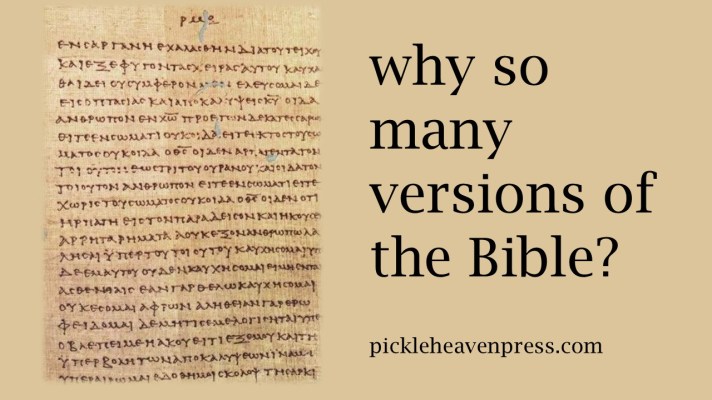
There are approximately 50 different English translations of the Bible which are currently being published. Which is why, come Sunday morning the pastor may preach from a version that is different from the one on our laps and may not even match the version projected on the video screen.
So, when the pastor tells us to read our Bibles, we need to ask, “Well, which one?” Why are there so many versions of the Bible?
The Bible was originally written in Hebrew and Greek, so it must be translated for us – which is a challenge because…
– language evolves. The KJV used the word “wist” in Mark 9:6. Most of us, “wist” we understood what it means. The NIV replaced it with the words “did not know” which certainly fits the word wist. We need a Bible translation that reflects the language that we speak and understand.
– there are different translation approaches.
There is not agreement as to the philosophy that underlies translation
a. There is the word-for-word approach. (NASB) The object is to translate word-for-word what the ancient Hebrew and Greek manuscripts say. This type of translation is reliably true, but a little wooden to read.
b. There is the thought-for-thought approach which strives to translate biblical ideas when words are not enough. (NIV)
For instance, Genesis 1:27 says, “God created man in His own image, in the image of God He created him; male and female He created them” (NASB). The word mankind, or people would better capture the intended meaning here than the word man.
The disadvantage of this approach is that it sometimes results in “this is what I think it means” instead of “this is what it says.”
– there is new manuscript evidence. When the Dead Sea Scrolls were discovered in 1946, they gave new insight as to how the ancient Hebrew language was used. The scrolls expanded the meanings of particular words and so on. A translator would want to incorporate this newly discovered information into a fresh translation.
– some readers have special needs. A quick way to discourage a kid from reading the Bible is to hand them the King James. They ain’t gonna understand it. So considerate translators have provided children’s translations. (ICB)
There are some reasonable reasons to have multiple translations, but – do we really need 50 of them? Publishers think we do!
– publishing the Bible is big business.
If every Christian were satisfied with just one Bible, the publishers would soon be out of business. The market would dry up. So, they continue to crank out new translations and then promote the idea that the new version is essential to our spiritual health.
And they expect the authors, who they also publish, to use quotations from their new Bible, so that readers will be influenced to buy the new version for themselves. All this guarantees a good profit margin and steady revenue.
Bible sales net $350-500 million annually. The two biggest producers of Bibles are Zondervan and Thomas Nelson. Both are currently owned by secular publisher Harper-Collins which is owned by Newscorp – Rupert Murdoch’s massive media company. Publishing the Bible is big, big business – unfortunately.
But we really don’t need so many Bible versions. The differences between good translations are usually inconsequential.
So what version is best to use? I prefer and strongly recommend the word-for-word versions – such as the New American Standard Bible (NASB) the English Standard Version (ESV) the New King James Version (NKJV) or the NETBible.com
Why? Because they accurately and meaningfully communicate word-for word what the inspired authors once wrote. To translate in any other way is to allow culture to influence the meaning of the Scripture, when it is Scripture that needs to influence culture. Culture changes over time, the Word of God does not.
A PRAYER: Lord, I speak of Your Word. May Your Word speak to me.
This has been Jim Johnson and pickleheavenpress.com
May the grace of our Lord Jesus be with you.

